
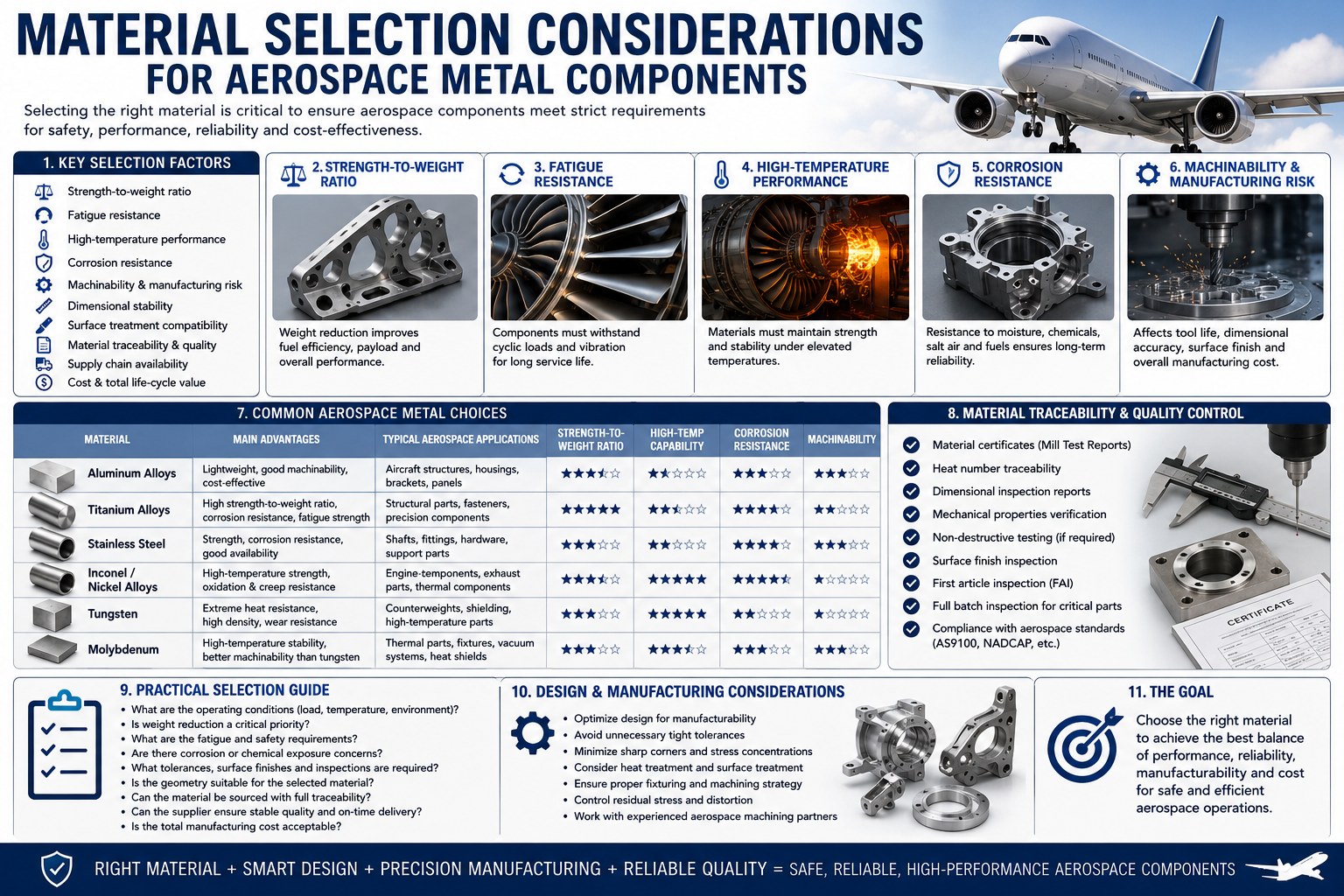
Aerospace metal components are required to perform under demanding conditions such as high mechanical load, vibration, fatigue, temperature variation, corrosion, pressure, and strict weight limitations. Because of these requirements, material selection is one of the most important decisions in aerospace component development.
For aerospace applications, the best material is not always the strongest or the most expensive material. It must provide the right balance of strength, weight, fatigue resistance, temperature capability, corrosion resistance, machinability, inspection feasibility, and supply chain reliability.
A good material selection process helps reduce manufacturing risk, control cost, improve service life, and ensure component reliability.
1. Key Factors in Aerospace Material Selection
Aerospace components are often designed with very specific performance targets. Before choosing a material, engineers usually need to evaluate the operating environment, mechanical load, safety factor, certification requirements, and manufacturing process.
Important selection factors include:
- Strength-to-weight ratio
- Fatigue resistance
- Fracture toughness
- High-temperature performance
- Corrosion resistance
- Thermal stability
- Machinability
- Dimensional stability
- Surface treatment compatibility
- Material traceability
- Inspection and quality requirements
- Long-term supply availability
In aerospace projects, material selection should always be connected with manufacturing feasibility. A material that looks ideal on paper may become difficult or expensive if the part geometry, tolerance, or production process is not practical.
2. Strength-to-Weight Ratio
Weight reduction is a major priority in aerospace design. Lower component weight can improve fuel efficiency, payload capacity, flight performance, and system response.
This is why titanium alloys and high-strength aluminum alloys are widely used in aerospace structures. Titanium provides excellent strength-to-weight ratio, corrosion resistance, and fatigue performance, making it suitable for brackets, structural fittings, housings, and aircraft-related precision parts.
However, weight is not the only factor. In high-temperature areas, nickel-based superalloys may be required even though they are much heavier than titanium. Material choice must match the actual service condition.
In simple terms:
Use lightweight alloys when weight reduction is critical.
Use high-temperature alloys when thermal strength is more important than weight.
3. Fatigue Resistance and Service Life
Aerospace components often experience repeated loading, vibration, and cyclic stress. Even when the applied load is below the static strength limit, repeated stress can cause fatigue failure over time.
For this reason, fatigue resistance is extremely important for aircraft structures, engine-related parts, fasteners, brackets, landing gear components, and rotating assemblies.
Material selection should consider:
- Cyclic load level
- Stress concentration areas
- Surface finish
- Internal defects
- Heat treatment condition
- Machining marks
- Sharp corners and notch sensitivity
- Inspection method
Good material alone is not enough. Poor machining, sharp internal corners, rough surface finish, or uncontrolled residual stress can reduce fatigue performance significantly.
4. High-Temperature Performance
Some aerospace components operate near engines, exhaust systems, thermal shields, turbines, or high-speed airflow environments. In these areas, materials must maintain strength and dimensional stability under heat.
Nickel-based superalloys such as Inconel 718 and Inconel 625 are commonly used when high-temperature strength, oxidation resistance, and thermal stability are required.
Titanium alloys can perform well in many structural applications, but they are not suitable for all high-temperature environments. At elevated temperatures, titanium may lose strength or face oxidation limitations depending on the alloy and working condition.
For high-temperature aerospace parts, engineers need to consider:
- Continuous operating temperature
- Peak temperature
- Thermal cycling
- Creep resistance
- Oxidation resistance
- Thermal expansion
- Cooling or insulation conditions
The correct material must maintain mechanical performance throughout the full service cycle, not only at room temperature.
5. Corrosion Resistance
Aerospace components may be exposed to moisture, fuel, hydraulic fluid, salt atmosphere, cleaning chemicals, and temperature changes. Corrosion can reduce strength, create cracks, affect assembly performance, and shorten service life.
Titanium alloys provide excellent corrosion resistance in many aerospace and marine-related environments. Stainless steels and nickel-based alloys may also be used when corrosion resistance and mechanical strength are both required.
Material selection should evaluate:
- Operating atmosphere
- Chemical exposure
- Galvanic corrosion risk
- Contact with other metals
- Surface treatment requirements
- Maintenance cycle
- Long-term environmental exposure
For assemblies using different metals, galvanic corrosion should be considered carefully. The material itself may be corrosion-resistant, but contact with another metal in a conductive environment can create corrosion risk.
6. Machinability and Manufacturing Risk
Aerospace parts often require complex geometry, tight tolerances, thin walls, high surface quality, and strict inspection. Therefore, machinability is a critical factor in material selection.
Titanium, Inconel, tungsten, molybdenum, and other special metals all require experienced machining control. Compared with common steels or aluminum, these materials can increase tool wear, machining time, distortion risk, and inspection cost.
Common manufacturing concerns include:
- Tool wear
- Heat concentration
- Work hardening
- Thin-wall deformation
- Residual stress
- Burr control
- Surface finish consistency
- Dimensional stability
- Fixturing difficulty
- Inspection accessibility
When selecting a material, engineers should also consider whether the part can be manufactured consistently and economically. Early DFM review can help reduce unnecessary cost and avoid production problems.
7. Tolerance and Geometry Design
In aerospace components, tight tolerances are often necessary. However, unnecessary over-tight tolerances can greatly increase machining cost and lead time, especially when using difficult-to-machine materials.
Good tolerance design should separate critical features from non-critical features. Functional surfaces, assembly interfaces, sealing areas, bearing locations, and datum structures may require tighter control. Other areas may allow more practical tolerances.
Designers should pay attention to:
- Thin-wall sections
- Deep pockets
- Long slender features
- Sharp internal corners
- Small holes
- Thread depth
- Flatness and parallelism requirements
- Datum selection
- Inspection method
For special metal aerospace parts, geometry optimization can sometimes reduce cost more effectively than negotiating material price.
8. Material Traceability and Quality Control
Aerospace projects usually require strict material traceability and quality documentation. Buyers may request mill certificates, heat numbers, chemical composition reports, mechanical property reports, inspection records, and sometimes special process documentation.
Typical quality requirements may include:
- Material certificate
- Heat number traceability
- Dimensional inspection report
- Surface finish inspection
- Hardness test
- Non-destructive testing if required
- RoHS or REACH support if applicable
- First article inspection
- Full batch inspection for critical parts
For aerospace components, documentation is part of the product. A supplier must not only machine the part correctly but also provide reliable records to support customer quality systems.
| Material | Main Advantage | Typical Aerospace Use |
|---|---|---|
| Aluminum Alloys | Lightweight, good machinability | Aircraft structures, housings, brackets |
| Titanium Alloys | High strength-to-weight ratio, corrosion resistance | Structural parts, fasteners, precision components |
| Stainless Steel | Strength, corrosion resistance, availability | Shafts, fittings, hardware, support parts |
| Inconel / Nickel Alloys | High-temperature strength, oxidation resistance | Engine-related parts, exhaust parts, thermal components |
| Tungsten | Extreme heat resistance, high density | Counterweights, shielding, high-temperature parts |
| Molybdenum | High-temperature stability, better machinability than tungsten | Thermal parts, fixtures, vacuum/high-temperature systems |
Each material has its own advantages and limitations. The final choice should depend on the actual load, temperature, environment, weight target, machining difficulty, and quality requirements.
10. Practical Selection Guide
For aerospace metal components, material selection can be simplified by asking several practical questions:
- Is weight reduction critical?
- Will the part operate at high temperature?
- Is fatigue performance important?
- Will the part contact corrosive media or salt atmosphere?
- Are there strict tolerance or surface finish requirements?
- Is the geometry suitable for the selected material?
- Can the material be sourced with proper traceability?
- Can the supplier provide stable machining and inspection capability?
- Will the total manufacturing cost still be acceptable?
The best material is the one that meets performance requirements while also being manufacturable, inspectable, and commercially practical.
Conclusion
Material selection for aerospace metal components requires a balance between engineering performance and manufacturing reality.
Titanium is often selected for lightweight structural parts. Inconel and other nickel-based alloys are preferred for high-temperature and severe-service components. Tungsten and molybdenum are used when extreme heat, density, or thermal stability is required. Aluminum and stainless steel remain practical choices for many structural and general-purpose aerospace applications.
For critical aerospace components, material selection should not be treated as a separate decision from machining. The best results come from combining material knowledge, DFM review, precision machining strategy, quality inspection, and complete documentation from the beginning of the project.