
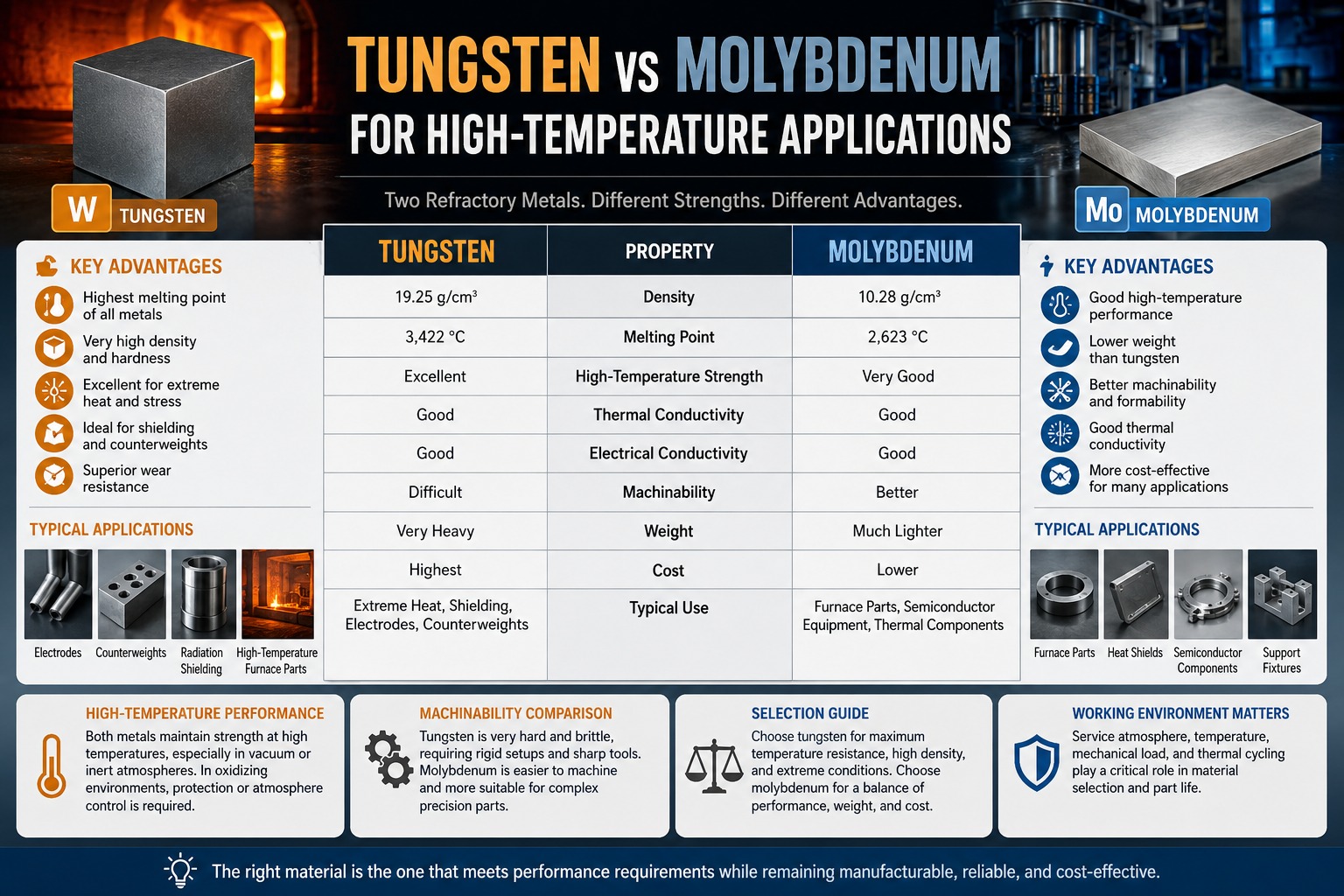
Tungsten and molybdenum are both refractory metals widely used in high-temperature engineering environments. They are selected when conventional steels, stainless steels, and many nickel-based alloys cannot provide enough thermal stability, melting resistance, or dimensional performance.
Although tungsten and molybdenum are often discussed together, they are not interchangeable. Tungsten offers extremely high melting point, high density, high hardness, and excellent resistance to thermal deformation. Molybdenum is lighter, easier to machine, more practical for many structural applications, and offers good thermal conductivity and dimensional stability.
For engineers and buyers, the correct material choice depends on temperature, load, atmosphere, weight limitation, machining complexity, and cost target.
| Factor | Tungsten | Molybdenum |
|---|---|---|
| Material Type | Refractory metal | Refractory metal |
| Density | Very high | Medium-high |
| Melting Point | Extremely high | Very high |
| High-Temperature Strength | Excellent | Very good |
| Thermal Conductivity | Good | Good |
| Electrical Conductivity | Good | Good |
| Machinability | Difficult | Better than tungsten |
| Weight | Very heavy | Much lighter than tungsten |
| Typical Use | Extreme heat, shielding, electrodes, counterweights | Furnace parts, semiconductor equipment, thermal components |
Tungsten is usually selected when the application requires maximum resistance to heat, wear, mass, or radiation shielding. Molybdenum is often preferred when a balance between high-temperature performance, manufacturability, and cost is required.
2. High-Temperature Performance
Tungsten has one of the highest melting points among all metals. This makes it suitable for extremely high-temperature applications such as furnace components, electrodes, aerospace-related thermal parts, and high-energy equipment.
Molybdenum also performs well at elevated temperatures, but its melting point and high-temperature strength are lower than tungsten. However, molybdenum is often easier to use in real manufacturing because it is lighter, more machinable, and more cost-effective for many precision components.
In practical selection:
Choose tungsten when maximum temperature resistance is the priority.
Choose molybdenum when high-temperature performance and manufacturability must be balanced.
3. Oxidation and Service Environment
A very important point is that both tungsten and molybdenum have limitations in oxidizing environments at high temperatures.
In vacuum, inert gas, hydrogen, or controlled atmospheres, both materials can perform very well. This is why they are commonly used in vacuum furnaces, semiconductor equipment, sapphire growth systems, high-temperature fixtures, and thermal processing equipment.
However, in open-air high-temperature service, both materials can oxidize. For applications exposed to oxygen at elevated temperatures, protective coatings, atmosphere control, or alternative materials may be required.
Therefore, “high-temperature capability” should always be considered together with the actual working atmosphere.
Key factors include:
- Operating temperature
- Vacuum or air exposure
- Oxygen content
- Thermal cycling
- Mechanical load
- Required service life
- Surface protection requirements
Ignoring the service atmosphere can lead to premature material failure, even when the base metal has excellent high-temperature properties.
4. Mechanical and Dimensional Stability
Tungsten provides excellent hardness, stiffness, and resistance to deformation. Its high density also makes it useful for counterweights, radiation shielding, vibration damping, and compact heavy components.
Molybdenum offers good dimensional stability at high temperatures and is often used when parts must remain accurate under heat. Because it is significantly lighter than tungsten, molybdenum is often more practical for larger components, support structures, fixtures, and furnace assemblies.
For high-temperature precision parts, dimensional stability is often just as important as melting point. The selected material must maintain shape, tolerance, and mechanical function under thermal stress.
5. Machinability Comparison
Both tungsten and molybdenum are more difficult to machine than common engineering metals. However, molybdenum is generally easier to machine than tungsten.
Tungsten Machining Characteristics
Tungsten is hard, dense, and brittle compared with many other metals. Machining tungsten requires rigid equipment, stable fixturing, sharp tools, and controlled cutting conditions. Because of its high hardness and brittleness, improper machining can cause edge chipping, cracking, poor surface finish, and tool wear.
Common tungsten machining concerns include:
- High cutting force
- Tool wear
- Brittleness and edge chipping
- Difficulty in drilling small holes
- Risk of cracking in thin or sharp features
- Higher machining cost
Tungsten parts should be designed with practical machining limitations in mind. Sharp internal corners, very thin walls, deep narrow slots, and unnecessary tight tolerances can greatly increase cost and risk.
Molybdenum Machining Characteristics
Molybdenum is still a special metal, but it is usually more machinable than tungsten. It can be turned, milled, drilled, and ground with suitable tools and process control.
Molybdenum is commonly used for precision machined parts because it provides a better balance between high-temperature performance and manufacturing feasibility.
Common molybdenum machining concerns include:
- Workpiece brittleness in certain conditions
- Tool wear under improper parameters
- Edge breakage on thin features
- Need for stable fixturing
- Surface finish control
- Careful handling to avoid damage
Compared with tungsten, molybdenum usually allows more flexible part geometry and more economical machining.
6. Cost and Manufacturing Considerations
Tungsten parts are generally more expensive to manufacture due to raw material cost, high density, machining difficulty, and tool wear. For complex precision parts, tungsten machining cost can rise quickly.
Molybdenum is often more cost-effective when the application does not require tungsten’s extreme density or maximum temperature capability. It is especially suitable for furnace fixtures, semiconductor components, thermal shields, supports, plates, and precision high-temperature parts.
Cost control should consider:
- Material grade and purity
- Part size and weight
- Machining complexity
- Tolerance requirements
- Surface finish requirements
- Quantity and batch size
- Inspection requirements
- Packaging and handling requirements
For refractory metal parts, early DFM review is very important. A small geometry change can significantly improve machinability and reduce cost.
7. When to Choose Tungsten
Tungsten is usually preferred when the application requires:
- Extremely high melting point
- High density
- High hardness
- Wear resistance
- Radiation shielding
- Compact heavy mass
- Severe thermal conditions
- Electrical or thermal performance under extreme environments
Typical tungsten applications include electrodes, counterweights, radiation shielding parts, high-temperature furnace components, aerospace thermal parts, and high-energy equipment components.
8. When to Choose Molybdenum
Molybdenum is usually preferred when the application requires:
- High-temperature stability
- Lower weight than tungsten
- Better machinability
- Good thermal conductivity
- Dimensional stability
- More practical manufacturing cost
- Precision machined high-temperature components
Typical molybdenum applications include vacuum furnace parts, heat shields, semiconductor equipment components, sapphire growth system parts, support fixtures, thermal processing components, and precision machined plates or rings.
| Requirement | Better Choice |
|---|---|
| Maximum temperature resistance | Tungsten |
| Lower weight | Molybdenum |
| Easier machining | Molybdenum |
| High density or shielding | Tungsten |
| Better cost balance | Molybdenum |
| Extreme hardness | Tungsten |
| Large precision furnace parts | Molybdenum |
| Compact heavy components | Tungsten |
In real projects, the final decision should not depend on a single property. The best material is the one that meets performance requirements while remaining manufacturable, inspectable, and commercially practical.
Conclusion
Tungsten and molybdenum are both valuable refractory metals for high-temperature applications, but they serve different engineering purposes.
Tungsten provides superior extreme-temperature capability, high density, hardness, and resistance to deformation. It is suitable for severe thermal, shielding, and high-energy applications where maximum material performance is required.
Molybdenum provides a more balanced solution. It offers strong high-temperature performance, lower weight, better machinability, and more practical manufacturing cost. For many furnace, semiconductor, and precision thermal components, molybdenum is often the more efficient choice.
For successful part development, material selection should be combined with DFM review, machining strategy, tolerance control, atmosphere evaluation, and reliable quality inspection from the quotation stage.