
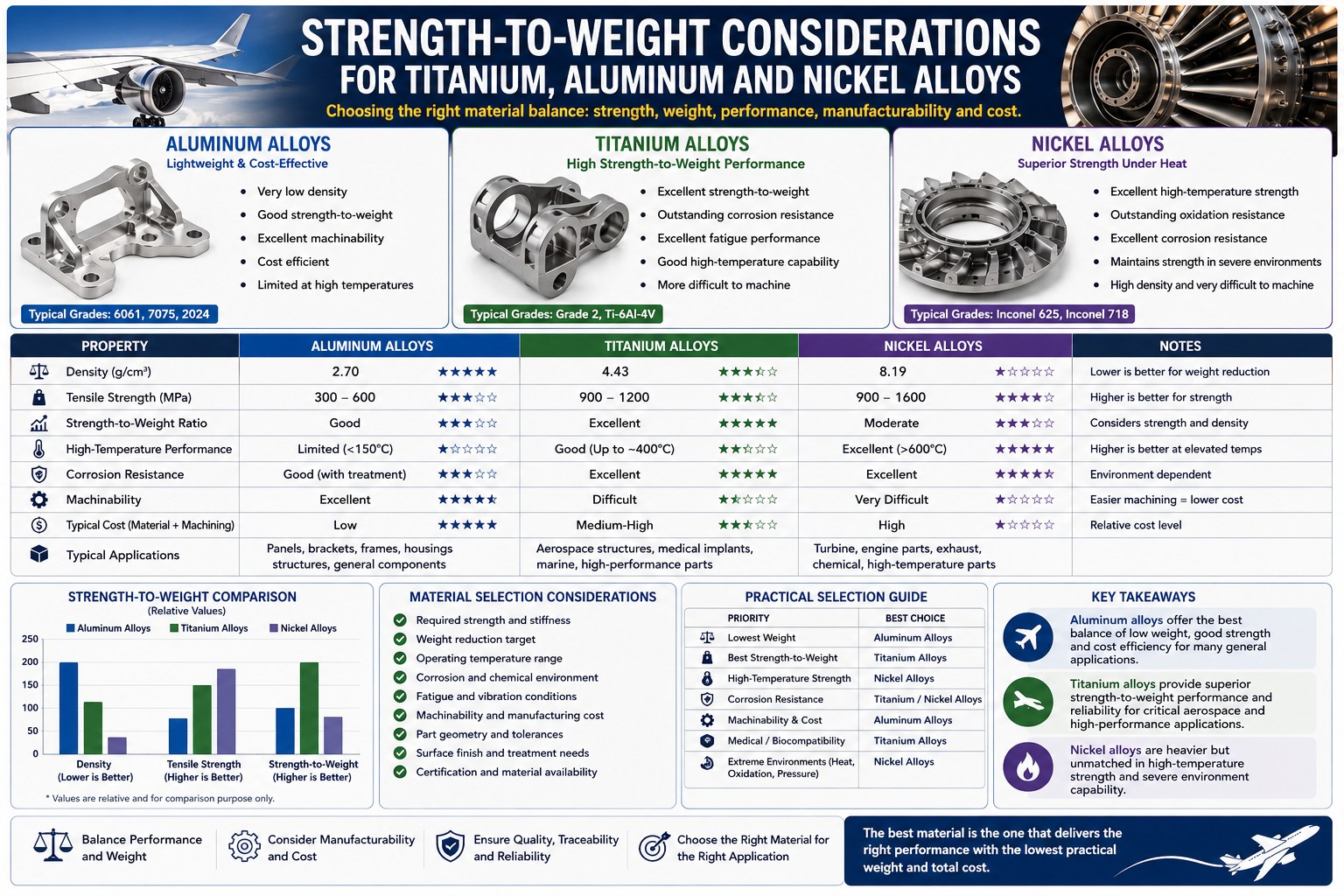
Strength-to-weight ratio is one of the most important factors in aerospace, robotics, medical devices, high-performance equipment, and precision mechanical systems. A material with a good strength-to-weight ratio can provide the required mechanical performance while reducing component weight.
Titanium, aluminum, and nickel alloys are often considered for demanding metal components, but they serve different engineering purposes. Aluminum is lightweight and cost-effective. Titanium offers excellent strength-to-weight performance and corrosion resistance. Nickel alloys provide superior high-temperature strength, but with much higher density.
The right material choice depends on load, weight target, temperature, corrosion environment, machining difficulty, and total manufacturing cost.
| Factor | Aluminum Alloys | Titanium Alloys | Nickel Alloys |
|---|---|---|---|
| Typical Grades | 6061, 7075, 2024 | Grade 2, Ti-6Al-4V | Inconel 625, Inconel 718 |
| Density | Very low | Medium-low | High |
| Strength-to-Weight Ratio | Good to excellent | Excellent | Moderate |
| High-Temperature Performance | Limited | Good | Excellent |
| Corrosion Resistance | Good with proper treatment | Excellent | Excellent |
| Machinability | Good | Difficult | Very difficult |
| Typical Advantage | Lightweight and economical | Lightweight strength and durability | Heat and severe-service performance |
| Typical Use | Housings, brackets, panels | Aerospace, medical, precision parts | Turbine, exhaust, chemical, high-temperature parts |
Aluminum is usually selected when weight and cost are the main priorities. Titanium is selected when higher strength, corrosion resistance, and reliability are required. Nickel alloys are selected when strength must be maintained at high temperature or in aggressive environments.
2. Aluminum Alloys: Lightweight and Practical
Aluminum alloys are widely used because they are light, machinable, and cost-effective. For many structural components, housings, brackets, plates, and frames, aluminum provides a practical balance of strength, weight, and manufacturing efficiency.
High-strength aluminum alloys such as 7075 and 2024 are commonly used in aerospace and transportation applications. They offer good strength-to-weight performance and are much easier to machine than titanium or nickel alloys.
However, aluminum has limitations. Its strength decreases significantly at elevated temperatures, and some grades require surface treatment to improve corrosion resistance. Aluminum may not be suitable for severe thermal, wear, or chemical environments.
Aluminum is usually a good choice when the application requires:
- Low weight
- Good machinability
- Cost efficiency
- Medium mechanical strength
- Fast production
- Good surface finishing options
Typical applications include aircraft panels, brackets, electronic housings, automation frames, fixtures, and lightweight structural parts.
3. Titanium Alloys: High Strength-to-Weight Performance
Titanium alloys, especially Ti-6Al-4V, are known for excellent strength-to-weight ratio. Titanium is much lighter than steel and nickel alloys while offering strong mechanical performance, corrosion resistance, and fatigue behavior.
This makes titanium highly suitable for aerospace structures, medical implants, marine components, precision mechanical parts, and high-performance equipment where both strength and weight are important.
Titanium also performs well in corrosive environments, including seawater and many chemical conditions. Its biocompatibility makes it valuable for medical and surgical applications.
However, titanium is more difficult to machine than aluminum. It has low thermal conductivity, which causes heat to concentrate near the cutting edge. It also requires sharp tools, stable fixturing, proper coolant control, and carefully selected cutting parameters.
Titanium is usually a good choice when the application requires:
- Excellent strength-to-weight ratio
- Corrosion resistance
- Fatigue resistance
- Biocompatibility
- Higher reliability than aluminum
- Weight reduction compared with steel or nickel alloys
Typical applications include aerospace brackets, structural fittings, medical implants, marine parts, robotic components, and precision housings.
4. Nickel Alloys: Heavy but Strong Under Heat
Nickel alloys, such as Inconel 625 and Inconel 718, are not usually selected for weight reduction. Their density is much higher than aluminum and titanium. However, they are selected when parts must survive high temperature, oxidation, pressure, corrosion, or severe mechanical stress.
In high-temperature applications, nickel alloys can maintain strength much better than aluminum or titanium. This makes them important for turbine components, exhaust systems, engine-related parts, chemical processing equipment, and oil and gas tools.
From a strength-to-weight perspective, nickel alloys may not look attractive. But in extreme environments, the ability to maintain strength under heat is often more important than low weight.
Nickel alloys are usually a good choice when the application requires:
- High-temperature strength
- Oxidation resistance
- Creep resistance
- Chemical corrosion resistance
- Stability under thermal cycling
- Severe-service durability
- Long-term reliability under heat and stress
Typical applications include aerospace engine parts, turbine components, exhaust components, heat-resistant fasteners, chemical processing parts, and high-temperature fixtures.
5. Strength-to-Weight Is Not Only About Strength
A common mistake is to compare materials only by tensile strength and density. In real engineering applications, strength-to-weight selection must also consider how the part will actually work.
Important factors include:
- Static load
- Fatigue load
- Impact or vibration
- Operating temperature
- Corrosion environment
- Wear condition
- Part geometry
- Wall thickness
- Surface finish
- Manufacturing process
- Inspection requirements
- Total part cost
For example, aluminum may be ideal for a lightweight housing, but not suitable near an engine or high-temperature zone. Titanium may be better for a structural aerospace bracket, but more expensive to machine. Nickel alloy may be too heavy for general structures, but necessary for hot-section components.
The best material is not always the lightest material. It is the material that provides reliable performance at the lowest practical weight and cost.
6. Machinability and Cost Impact
Material selection directly affects machining cost. Aluminum is generally the easiest and most economical to machine. Titanium requires more control due to heat buildup, tool wear, and deformation risk. Nickel alloys are usually the most difficult due to work hardening, high cutting forces, and rapid tool wear.
| Material | Machining Difficulty | Typical Cost Impact |
|---|---|---|
| Aluminum Alloys | Low | Lower machining cost |
| Titanium Alloys | Medium-high | Higher machining cost |
| Nickel Alloys | High | Highest machining cost |
For precision components, machining difficulty can influence:
- Lead time
- Tooling cost
- Surface finish quality
- Tolerance control
- Scrap risk
- Inspection cost
- Final part price
Design for manufacturability is especially important when using titanium or nickel alloys. Avoiding unnecessary tight tolerances, deep pockets, thin walls, and sharp internal corners can significantly reduce manufacturing cost.
7. Temperature Changes the Selection Logic
At room temperature, aluminum and titanium may offer excellent weight advantages. But at elevated temperatures, material selection can change completely.
Aluminum loses strength quickly when temperature rises. Titanium performs better than aluminum in many thermal conditions, but it still has limits. Nickel alloys are heavier, but they maintain strength and oxidation resistance in high-temperature environments.
For this reason:
For low-temperature lightweight structures, aluminum may be the best choice.
For high-performance lightweight structures, titanium is often stronger.
For high-temperature severe-service parts, nickel alloys are usually necessary.
Temperature should always be evaluated before final material selection.
| Requirement | Recommended Material |
|---|---|
| Lowest weight | Aluminum |
| Best balance of strength and weight | Titanium |
| Lowest machining cost | Aluminum |
| Higher fatigue and corrosion resistance | Titanium |
| High-temperature strength | Nickel alloys |
| Severe chemical or thermal environment | Nickel alloys |
| Medical or biocompatible applications | Titanium |
| Cost-sensitive lightweight parts | Aluminum |
| Critical aerospace structural parts | Titanium |
| Engine or exhaust-related parts | Nickel alloys |
This guide is only a starting point. Final selection should consider actual load, temperature, environment, geometry, tolerance, and inspection requirements.
9. Design and Manufacturing Considerations
When selecting materials for strength-to-weight performance, engineers should also evaluate whether the design can be manufactured reliably.
Important design considerations include:
- Can the wall thickness support machining stability?
- Are there unnecessary tight tolerances?
- Can sharp internal corners be replaced with practical radii?
- Will thin sections deform during machining?
- Is the selected material available in the required form?
- Can the supplier provide material certificates and traceability?
- Is the inspection method practical for the geometry?
- Can the final cost meet the project target?
A good material choice should support both performance and manufacturability.
Conclusion
Titanium, aluminum, and nickel alloys each offer different advantages in strength-to-weight design.
Aluminum is lightweight, machinable, and cost-effective, making it suitable for many housings, brackets, panels, and structural parts. Titanium provides excellent strength-to-weight ratio, corrosion resistance, and fatigue performance, making it ideal for aerospace, medical, marine, and precision applications. Nickel alloys are heavier, but they provide superior high-temperature strength and severe-service reliability.
For engineering teams, the best material is not simply the strongest or lightest option. It is the material that provides the right balance of weight, strength, temperature resistance, corrosion performance, machinability, quality control, and total manufacturing cost.