
Introduction
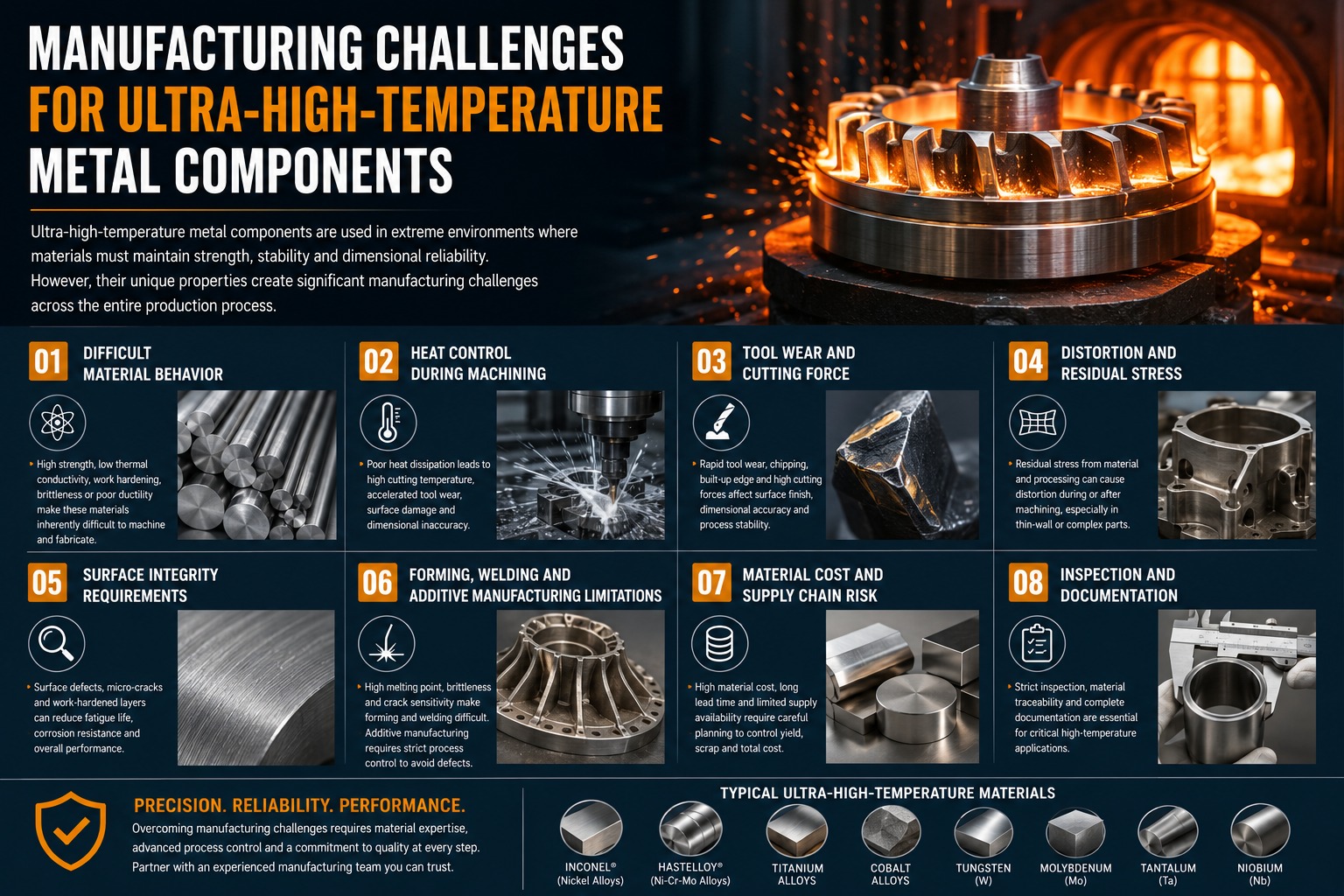
Ultra-high-temperature metal components are used in some of the most demanding industrial environments. Aerospace propulsion systems, semiconductor equipment, energy systems, high-temperature furnaces, vacuum equipment and advanced defense applications often require parts that can maintain strength, stability and dimensional reliability under extreme thermal conditions.
Materials used in these applications may include nickel-based superalloys, titanium alloys, cobalt-based alloys, tungsten, molybdenum, tantalum, niobium and other refractory metals. These materials offer excellent performance, but they also create serious manufacturing challenges.
For ultra-high-temperature components, the difficulty is not only machining hard materials. The real challenge is controlling material behavior, thermal stress, tool wear, surface integrity, distortion, inspection and documentation throughout the entire manufacturing process.
1. Difficult Material Behavior
Ultra-high-temperature materials are selected because they can survive where ordinary metals cannot. However, the same properties that make them valuable also make them difficult to manufacture.
Nickel-based superalloys such as Inconel 625 and Inconel 718 maintain strength at high temperatures, but they are difficult to machine due to low thermal conductivity, work hardening and high cutting forces. Refractory metals such as tungsten, molybdenum, tantalum and niobium have very high melting points and strong high-temperature capability, but they may also bring issues such as brittleness, oxidation sensitivity, poor ductility or difficult forming behavior.
This means that manufacturing strategy must be matched to the specific material, not only to the drawing.
2. Heat Control During Machining
Heat control is one of the most important challenges in machining ultra-high-temperature components.
In many high-performance alloys, cutting heat does not dissipate easily. This can increase tool wear, damage the machined surface, affect dimensional accuracy and reduce process stability. For Inconel 718, cutting temperature is a key factor affecting tool wear, surface integrity and chip behavior during high-speed milling.
A successful machining process requires suitable cutting speed, feed rate, tool material, coating, coolant strategy and toolpath design. If heat is not controlled, even a technically correct drawing can become difficult to produce reliably.
3. Tool Wear and Cutting Force
Ultra-high-temperature alloys often cause rapid tool wear. This may include flank wear, notch wear, chipping, built-up edge or tool breakage.
Tool wear is not only a cost issue. A worn tool can change cutting force, generate poor surface finish, create dimensional deviation and affect fatigue performance. For critical components, surface integrity may be just as important as final size.
Manufacturers need to control tool life carefully and avoid pushing tools beyond a safe process window. Stable production requires tool wear monitoring, proven cutting parameters and realistic cycle time planning.
4. Distortion and Residual Stress
Many ultra-high-temperature components have complex geometry, thin walls, deep cavities or precision sealing surfaces. These features are sensitive to distortion.
Residual stress may come from raw material production, forging, heat treatment, rough machining or welding. During machining, material removal can release internal stress and cause the part to move. For thin-wall or high-precision parts, this can create serious dimensional problems.
To reduce distortion, manufacturers may need staged machining, stress relief, balanced material removal, special fixturing and intermediate inspection. The machining sequence is often as important as the machine itself.
5. Surface Integrity Requirements
For components used in extreme environments, the machined surface must be carefully controlled.
Surface defects such as micro-cracks, tearing, excessive roughness, recast layers, smeared material or work-hardened layers can reduce part performance. In aerospace, energy and semiconductor applications, surface integrity may affect fatigue life, corrosion resistance, sealing performance or thermal behavior.
This is why process selection matters. Milling, turning, grinding, EDM, polishing or finishing operations must be selected according to the material, geometry and final application.
6. Forming, Welding and Additive Manufacturing Limitations
Some ultra-high-temperature metals are difficult to form, weld or fabricate using conventional methods. Refractory metals are especially challenging because of their high melting points, brittleness and sensitivity to processing conditions. Additive manufacturing is becoming more important for refractory materials because it can support near-net-shape production and complex geometry, but it can also introduce problems such as cracking, porosity and residual stress if process control is not strong enough.
For many advanced components, the best solution may be a hybrid route: near-net-shape forming or additive manufacturing first, followed by precision machining of critical features.
7. Material Cost and Supply Chain Risk
Ultra-high-temperature materials are often expensive and difficult to source. Some materials have long lead times, limited supplier availability or strict documentation requirements.
For example, molybdenum and its alloys are used in high-temperature furnaces, electrical and electronic devices, medical equipment, materials processing equipment and aerospace/defense components because of properties such as high thermal conductivity, low coefficient of thermal expansion, thermal shock resistance and high stiffness.
Because raw material cost can be high, manufacturers must consider stock size, yield, machining allowance and scrap control early in the project. Poor planning can make the final part unnecessarily expensive.
8. Inspection and Documentation
Ultra-high-temperature components are often used in critical systems, so inspection and documentation are essential.
Typical requirements may include material certificates, heat number traceability, dimensional inspection reports, surface roughness records, hardness testing, special process records and final quality documentation.
For advanced industries, customers are not only buying a machined part. They are buying confidence that the material, process and inspection have been properly controlled.
Conclusion
Manufacturing ultra-high-temperature metal components requires more than CNC machining capacity. It requires material knowledge, process engineering, heat control, distortion management, surface integrity control and reliable documentation.
Nickel-based superalloys, titanium alloys, cobalt-based alloys, tungsten, molybdenum, tantalum, niobium and other refractory metals can deliver excellent performance in extreme environments. However, they must be processed with the right manufacturing strategy.
Nova Special Metals supports precision machining and manufacturing solutions for demanding metal components used in aerospace, semiconductor, energy, medical and other advanced industries. Early engineering review can help identify manufacturing risks, improve cost control and increase the reliability of high-performance metal parts.