
Introduction
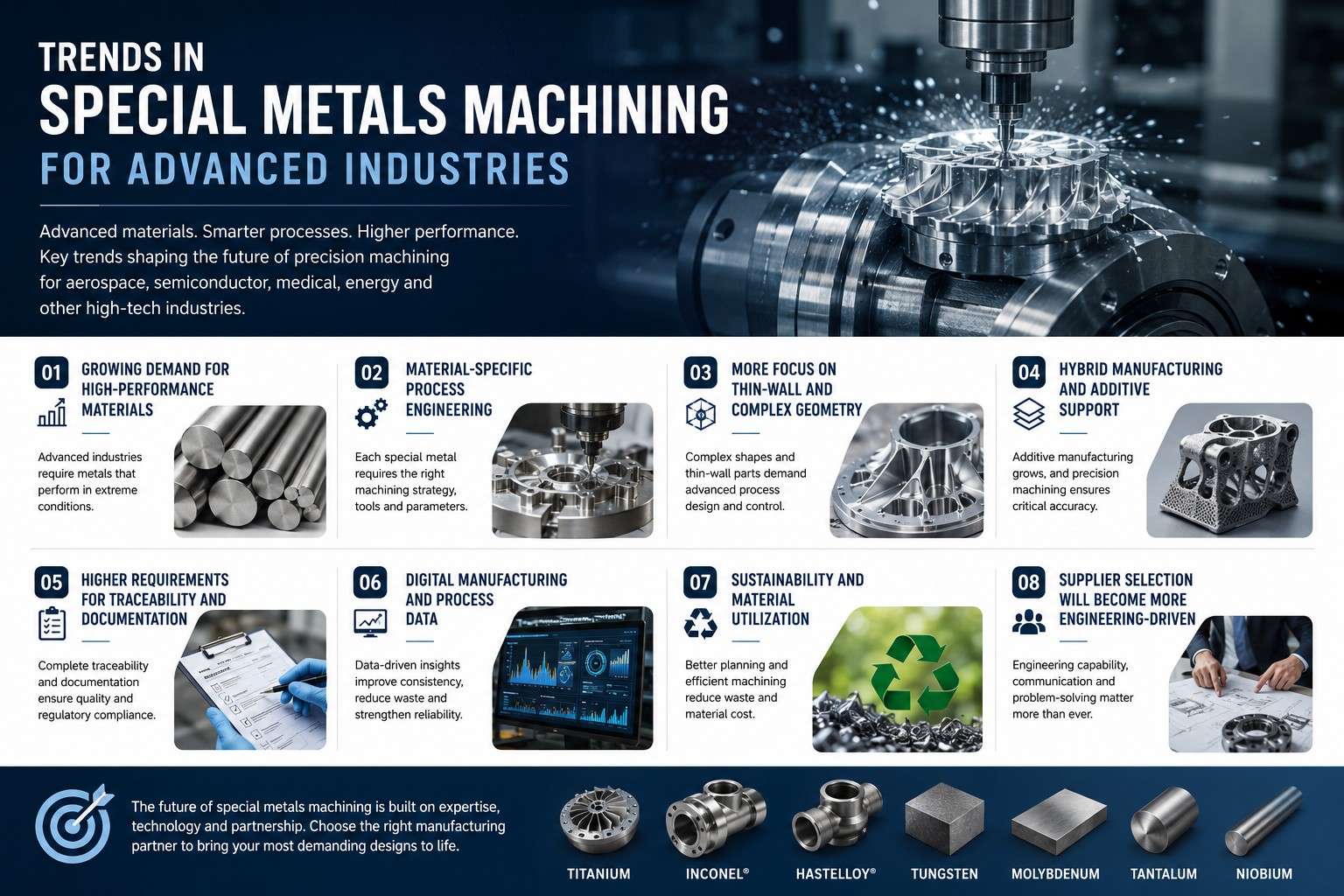
Advanced industries are placing higher demands on machined metal components. Aerospace, semiconductor equipment, medical devices, energy systems and defense applications increasingly require materials that can operate under high temperature, high stress, corrosion, vacuum or weight-sensitive conditions.
As a result, special metals such as titanium, Inconel, Hastelloy, tungsten, molybdenum, tantalum, niobium and cobalt-chrome alloys are becoming more important in precision manufacturing. However, these materials are also more difficult to machine than conventional steels or aluminum alloys.
The future of special metals machining is not only about cutting harder materials. It is about combining material knowledge, process control, tooling strategy, inspection capability and supply chain discipline to deliver reliable components for advanced applications.
1. Growing Demand for High-Performance Materials
Advanced industries are moving toward materials with higher strength, better heat resistance, improved corrosion resistance and longer service life.
Titanium alloys are widely used where strength-to-weight ratio is critical. Nickel-based superalloys such as Inconel 718 and Inconel 625 are selected for high-temperature and corrosive environments. Refractory metals such as tungsten, molybdenum, tantalum and niobium are used in applications involving extreme temperature, vacuum, chemical resistance or special electrical properties.
This trend creates more opportunities for manufacturers with real experience in difficult-to-machine materials, but it also raises the requirement for stable process planning and quality control.
2. From Standard CNC Machining to Material-Specific Process Engineering
For special metals, standard machining parameters are often not enough. Each material group requires a different approach.
Titanium requires careful heat control because it has low thermal conductivity. Inconel and Hastelloy require rigid setups, sharp tooling and stable chip control because of work hardening. Tungsten and molybdenum require attention to brittleness, edge chipping and grinding strategy. Tantalum and niobium may require special handling due to their ductility and surface behavior.
In the coming years, competitive suppliers will not simply quote based on drawings. They will need to review material, geometry, tolerance, surface finish, batch size and inspection requirements before defining the most reliable production route.
3. More Focus on Thin-Wall and Complex Geometry Components
Advanced industries increasingly use lightweight structures, compact assemblies and complex internal features. This creates higher demand for thin-wall parts, deep cavities, precision slots, special holes and complex 5-axis machined surfaces.
For special metals, these geometries are more challenging because internal stress, tool pressure and heat buildup can easily cause distortion or dimensional instability.
Future machining capability will depend more on process design, including roughing and finishing sequence, stress relief, fixture support, toolpath strategy and in-process measurement. The ability to prevent distortion before it happens will become more valuable than correcting problems after machining.
4. Hybrid Manufacturing and Additive Manufacturing Support
Additive manufacturing is becoming more common for titanium, nickel alloys and other advanced materials, especially when parts require complex shapes or low-volume production. However, most printed metal parts still require CNC machining, grinding, polishing or inspection after printing.
This creates a growing role for machining suppliers who can support hybrid workflows: near-net-shape production first, then precision machining of critical surfaces, holes, threads and sealing areas.
For many advanced components, the final performance depends not only on how the part is formed, but also on how accurately the functional surfaces are finished.
5. Higher Requirements for Traceability and Documentation
Advanced industries do not only buy parts. They buy controlled manufacturing evidence.
Material certificates, heat numbers, inspection reports, surface finish records, dimensional reports and special process documentation are becoming more important, especially for aerospace, medical, semiconductor and energy-related applications.
For special metals, traceability is particularly important because material substitution or uncontrolled processing can create serious performance risks. Future suppliers will need stronger documentation systems to support customer audits, quality reviews and long-term repeat orders.
6. Digital Manufacturing and Process Data
Digital manufacturing is becoming more important in precision machining. Process data, inspection data, tool life records and production history can help manufacturers improve consistency and reduce risk.
For special metals, this is especially useful because machining cost is high and process mistakes are expensive. Better data can help identify tool wear trends, improve cutting parameters, reduce scrap and support repeat production.
In the future, customers may increasingly prefer suppliers who can provide not only machined parts, but also a controlled and repeatable manufacturing process.
7. Sustainability and Material Utilization
Special metals are often expensive and difficult to source. Titanium, nickel alloys, tantalum, niobium, tungsten and molybdenum may involve high raw material cost, long lead time or limited supply availability.
This makes material utilization an important trend. Manufacturers need to reduce waste through better nesting, near-net-shape planning, optimized stock size selection and improved machining strategy.
For buyers, a supplier who understands material cost control can help reduce total project cost without sacrificing performance.
8. Supplier Selection Will Become More Engineering-Driven
As parts become more demanding, supplier selection will become less price-driven and more engineering-driven.
Customers in advanced industries need suppliers who can understand drawings, identify manufacturability risks, suggest practical improvements and communicate clearly during RFQ review. For special metals, the cheapest quote may not be the safest quote if the supplier does not understand the material behavior and inspection requirements.
A strong supplier should be able to support material selection, DFM review, machining strategy, tolerance evaluation and quality documentation before production starts.
Conclusion
Special metals machining is moving toward higher complexity, tighter process control and stronger engineering involvement. The key trends are clear: advanced materials, complex geometry, hybrid manufacturing, digital process control, stronger traceability and better material utilization.
For aerospace, semiconductor, medical, energy and other advanced industries, successful projects depend on more than CNC machine capacity. They require a manufacturing partner with material knowledge, process discipline and quality awareness.
Nova Special Metals focuses on precision machining solutions for titanium, nickel alloys, refractory metals and other high-performance materials. We support customers from RFQ review to production planning, machining, inspection and delivery documentation.
For special metal components with demanding performance requirements, early engineering communication can reduce cost, avoid manufacturing risk and improve project reliability.