
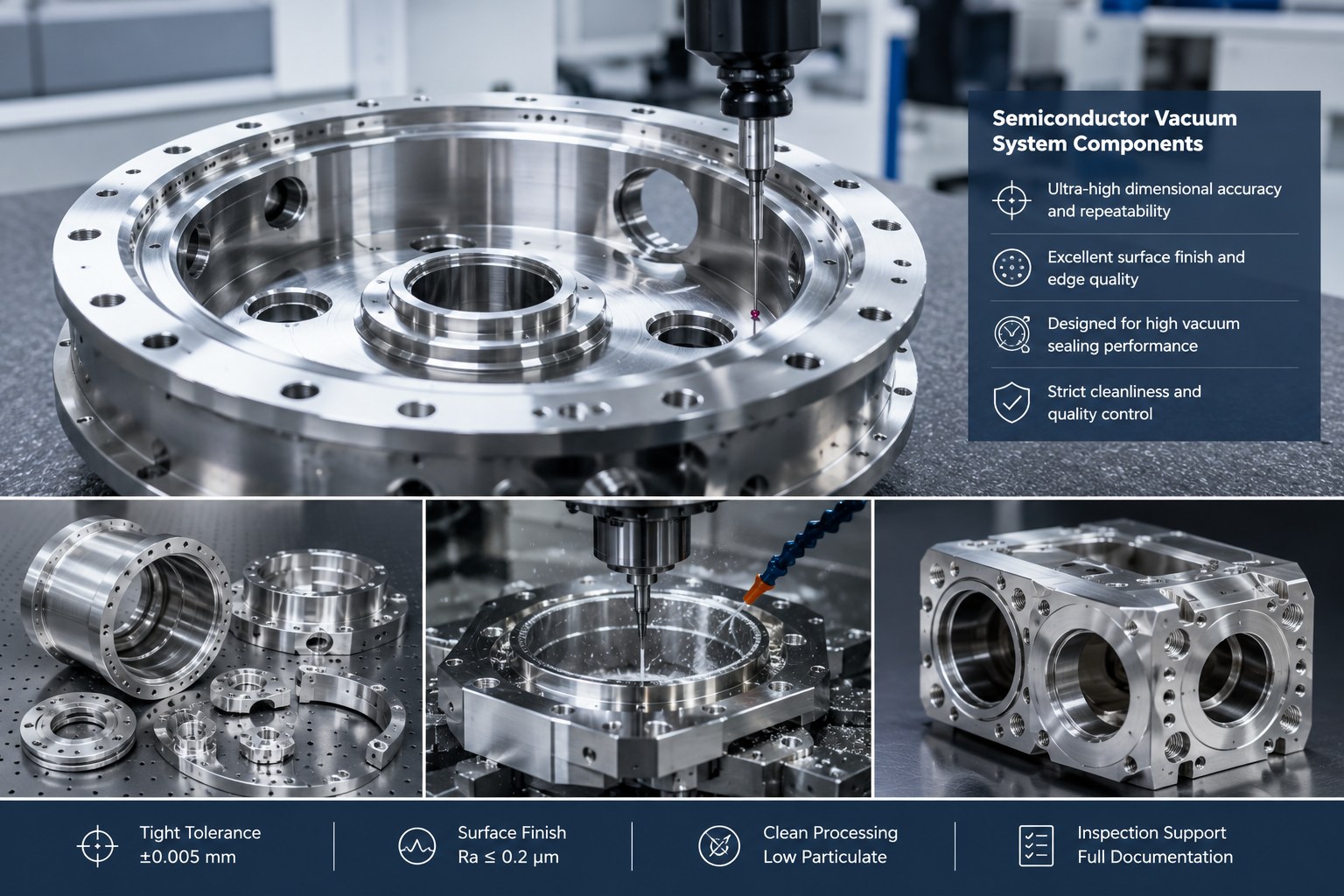
Project Background
A customer in the semiconductor equipment sector required ultra-precision machined metal components for use in a high-vacuum system. The parts were intended for critical equipment assemblies where dimensional accuracy, surface quality, cleanliness and material stability were all essential to overall system performance.
Semiconductor vacuum systems operate under highly controlled conditions. Components used in these systems must not only meet tight dimensional tolerances, but also support sealing performance, alignment accuracy and process stability. In many cases, even minor dimensional variation or surface inconsistency can affect vacuum integrity, assembly fit or long-term equipment reliability.
The project involved precision-machined parts with complex geometries, multiple sealing surfaces and fine-feature requirements. In addition to machining accuracy, the customer also expected a disciplined manufacturing approach and clear quality control support.
Engineering Challenge
The main challenge of this project was achieving ultra-precision machining quality suitable for semiconductor vacuum applications. Compared with conventional industrial components, vacuum system parts usually require tighter control of flatness, concentricity, hole position, surface finish and edge condition.
Several features of this project increased the machining difficulty. First, the parts included multiple sealing interfaces that required stable dimensional control and consistent surface quality. Any deviation in these areas could affect vacuum performance during final assembly.
Second, the component geometry contained fine details and thin sections that required careful machining strategy. If cutting force, tool condition or clamping pressure were not properly controlled, the part could experience dimensional shift or localized deformation.
Another challenge was cleanliness and process discipline. Semiconductor equipment customers often place high expectations on contamination control, burr control and overall machining consistency. This means the project required not only accurate machining, but also attention to edge quality, surface condition and inspection reliability.
In addition, many vacuum system parts must fit with other high-precision assemblies. Therefore, repeatability across multiple parts was just as important as achieving accuracy on a single component.
Nova’s Solution
Nova Special Metals supported the project with a precision-focused machining and inspection approach. Before production, the drawing was reviewed carefully to identify critical vacuum sealing surfaces, alignment features, fine-detail areas and tolerance-sensitive dimensions.
A controlled machining process was developed to reduce variation across each stage of production. Rough machining was used to establish the general geometry while protecting part stability. Semi-finishing helped prepare the component for final precision control. Final finishing was reserved for the most critical surfaces and dimensional features, allowing tighter control of form and surface consistency.
Special attention was given to tooling selection, clamping method and machining sequence. Stable workholding was used to support the part without introducing unnecessary stress. Tool paths were planned to maintain smooth cutting conditions, reduce vibration and improve surface integrity. For precision features, machining parameters were controlled carefully to reduce the risk of dimensional deviation and maintain repeatability.
Edge condition and burr control were also considered as part of the process. For semiconductor vacuum components, small burrs or unstable edge quality may create downstream assembly or cleanliness issues. Nova therefore applied careful process control to support clean, accurate finished features.
Quality inspection was integrated throughout production. Intermediate checks were used where necessary to monitor key dimensions before final machining. Final inspection focused on tolerance-critical features, sealing surfaces and overall dimensional consistency according to customer drawing requirements. Documentation support was also maintained to help the customer review machining quality with confidence.
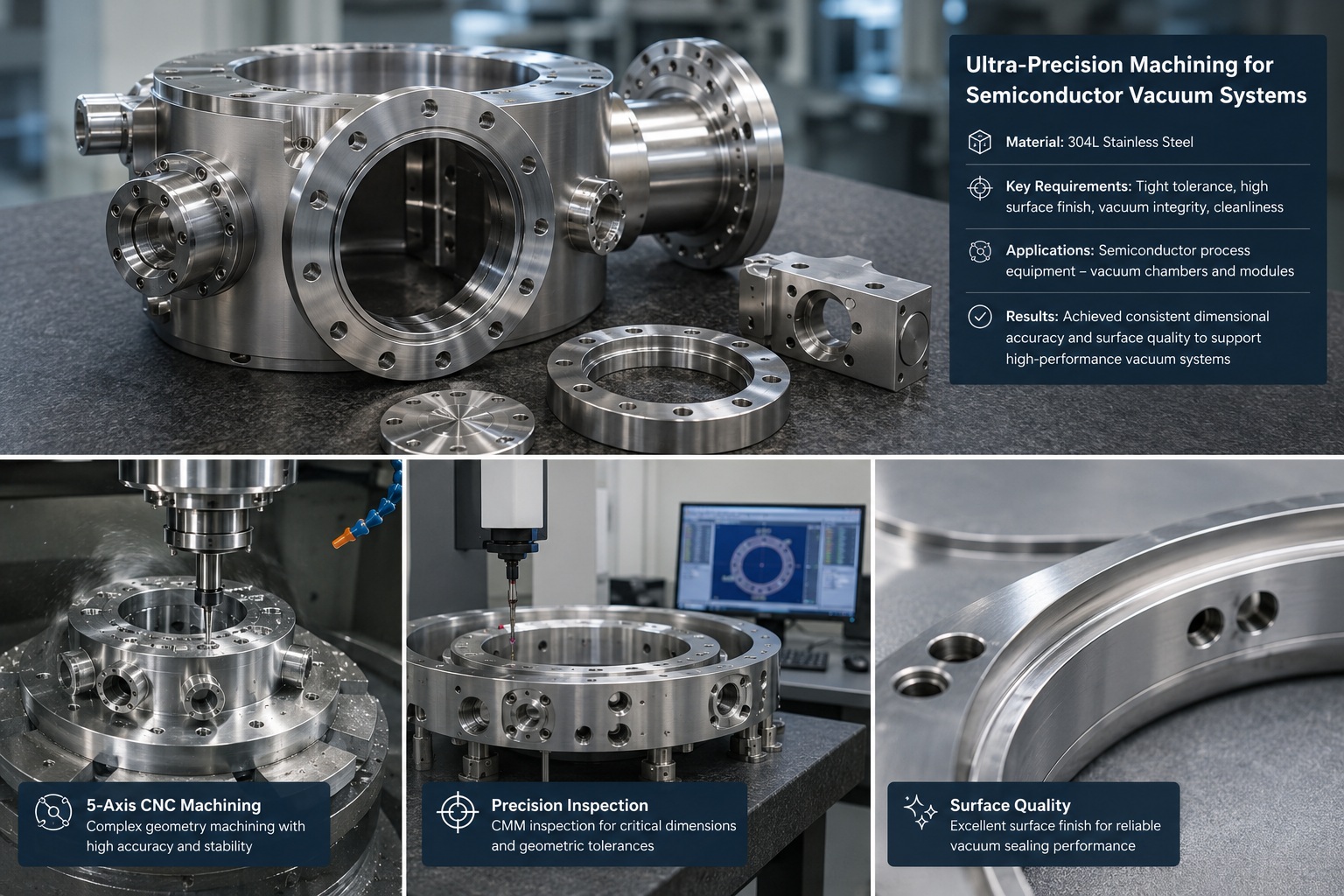
Achievement
Through careful machining strategy, stable process control and integrated inspection support, the vacuum system components were produced with reliable dimensional accuracy and consistent surface quality.
Key results included:
- Improved dimensional control for vacuum sealing interfaces
- Stable machining of fine-feature and tolerance-critical areas
- Better surface consistency for precision assembly applications
- Reduced burr and edge-quality risk in functional features
- Reliable inspection support for semiconductor equipment requirements
The project demonstrated Nova’s ability to support semiconductor-related precision machining programs where vacuum performance, repeatability and manufacturing discipline are critical.
Related Capability
Nova Special Metals provides precision machining support for semiconductor, aerospace, medical, energy and advanced industrial applications requiring high dimensional accuracy and process control.
For projects involving vacuum system parts, sealing surfaces, fine features, tight tolerances or complex precision assemblies, Nova can assist with DFM review, machining process planning, fixturing strategy, burr control and inspection coordination.