
Project Background
Tantalum is widely used in demanding process systems where corrosion resistance is a critical requirement. In chemical processing, pharmaceutical equipment, specialty reactors and high-purity fluid handling systems, many conventional metals may fail when exposed to strong acids, aggressive chemicals or highly corrosive operating environments.
Because of its excellent corrosion resistance, high chemical stability and good performance in severe process conditions, tantalum is often selected for critical components that must provide long-term reliability. However, tantalum is also an expensive and technically demanding material. Improper machining, welding, forming or surface handling can lead to high material loss, dimensional issues or unnecessary production risk.
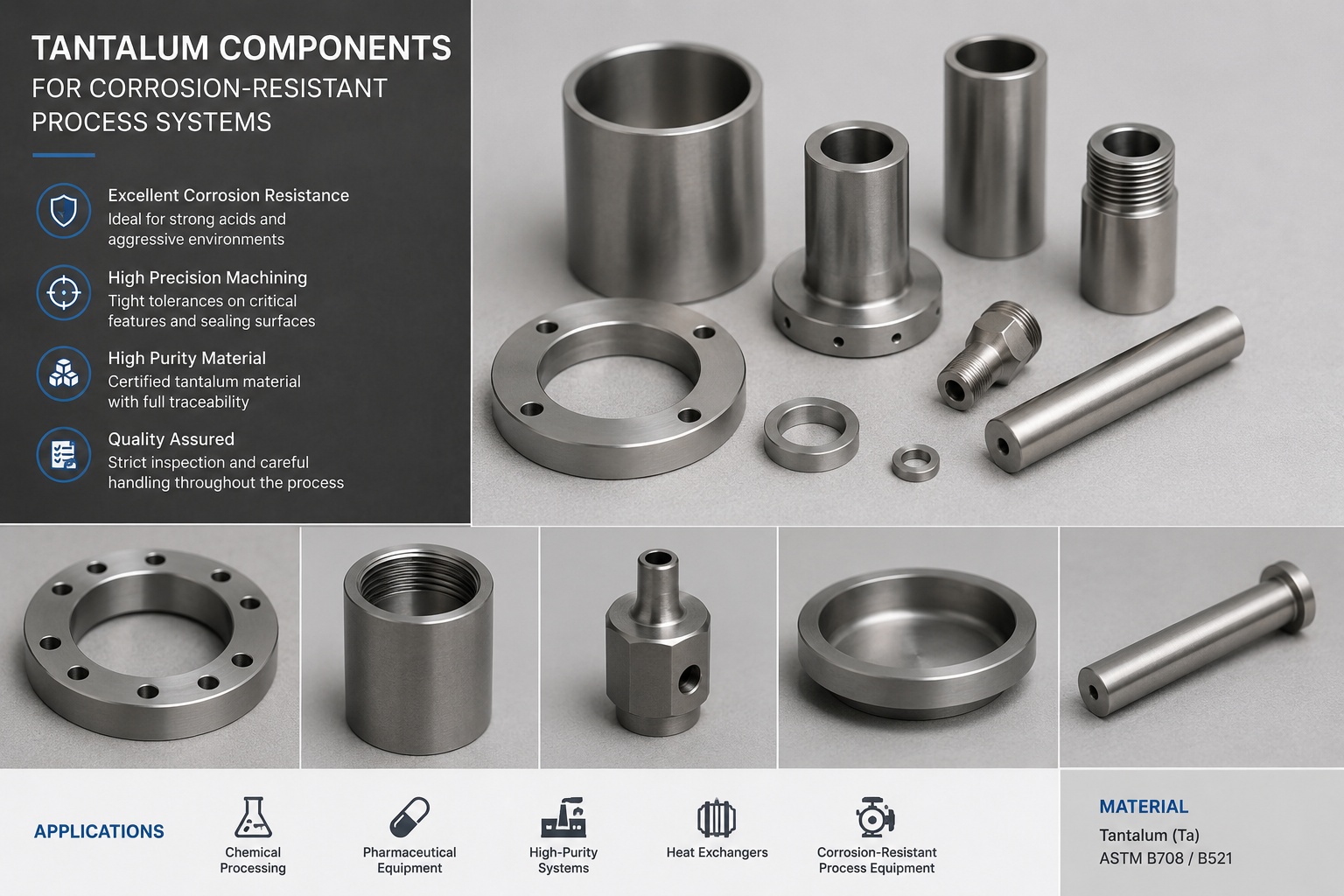
For this project, the customer required precision tantalum components used in corrosion-resistant process systems. The parts included sealing-related components, small flow-control elements, liners, sleeves, spacers and custom-machined parts used in chemical or high-purity processing equipment.
The key objective was to manufacture tantalum parts with stable dimensional accuracy, controlled surface condition and reliable material handling while reducing unnecessary machining risk and material waste.
Component Requirements
The components were designed for process equipment exposed to corrosive media. The main requirements included:
- High-purity tantalum material
- Excellent corrosion-resistant performance
- Tight dimensional control on functional features
- Smooth and clean machined surfaces
- Stable sealing and fitting dimensions
- Controlled burrs and edge conditions
- Material traceability documentation
- Careful packaging to avoid surface damage
Because these components may be installed in systems handling aggressive chemicals, the parts needed to maintain reliable performance under demanding operating conditions. Surface defects, uncontrolled scratches, poor edge finishing or incorrect material handling could affect sealing reliability, assembly quality or long-term service life.
Manufacturing Challenges
Tantalum is not a common machining material. Compared with stainless steel, aluminum or titanium, tantalum requires a more careful process strategy.
The main challenges included:
- High material cost and limited tolerance for production waste
- Soft and ductile material behavior during machining
- Risk of built-up edge and poor surface finish
- Difficulty maintaining sharp and accurate features
- Burr formation on holes, edges and thin sections
- Risk of surface contamination during processing
- Need for careful handling to protect functional surfaces
Although tantalum is not as hard as tungsten or some nickel-based superalloys, it can be difficult to machine cleanly because of its ductility and tendency to deform under improper cutting conditions. For precision process-system components, this means the machining process must be stable, controlled and carefully inspected.
Engineering and Process Approach
Before production, the drawings were reviewed to identify critical sealing areas, thin walls, hole features, internal corners and surfaces exposed to process media.
The manufacturing plan focused on reducing material waste, controlling cutting force and protecting the surface condition of the parts. Machining parameters were selected to avoid excessive heat, tool adhesion and deformation.
The process included:
- Material verification before machining
- Careful nesting and blank preparation to reduce waste
- Stable workholding to avoid part movement or distortion
- Sharp cutting tools suitable for ductile refractory metals
- Controlled cutting parameters to improve surface quality
- Step-by-step machining for critical dimensions
- Careful deburring without damaging sealing surfaces
- In-process inspection before final finishing
For tantalum parts, the goal was not aggressive material removal. The priority was clean machining, stable geometry and surface protection.
Surface and Edge Control
Surface quality was especially important for this project because the components were intended for corrosion-resistant process systems. Any uncontrolled surface damage could create potential weak points, contamination risks or assembly problems.
Special attention was given to:
- Functional sealing surfaces
- Internal holes and flow-related features
- Thin edges and transition areas
- Contact surfaces used for assembly
- Areas exposed to corrosive media
Edges were finished carefully to remove burrs while maintaining the required geometry. Over-polishing or excessive edge breaking was avoided because it could affect fitting accuracy or sealing performance.
The final surface condition was controlled to support both functional performance and long-term reliability in corrosive environments.
Inspection and Quality Control
Inspection was carried out during and after machining to ensure that critical dimensions remained within specification.
Quality control focused on both dimensional accuracy and surface integrity. The parts were inspected for burrs, scratches, deformation, surface defects and edge quality.
Typical inspection items included:
- Critical dimensional measurements
- Hole position and diameter verification
- Flatness and parallelism checks where required
- Visual inspection for scratches and surface damage
- Edge and burr inspection
- Verification of material documentation
- Final packaging inspection before shipment
For tantalum process-system components, inspection is not only about meeting drawing tolerances. It is also about confirming that the parts are suitable for use in highly corrosive operating environments.
Final Result
The tantalum components were successfully manufactured according to the customer’s technical requirements. The final parts achieved stable dimensional accuracy, clean surface condition and controlled edge quality.
Through careful machining strategy, material handling and inspection control, the project reduced the common risks associated with tantalum machining, including burr formation, surface damage, dimensional instability and unnecessary material waste.
The completed components were suitable for integration into corrosion-resistant process systems and related high-performance industrial equipment.
Engineering Value
This project demonstrated the importance of combining material knowledge with precision machining capability when working with tantalum.
Tantalum components are often selected for applications where corrosion resistance, chemical stability and long-term reliability are more important than material cost. Because of this, manufacturing quality must be controlled from material selection to final packaging.
NOVA supports precision machining of tantalum and other special metal components for chemical processing, pharmaceutical equipment, high-purity systems, semiconductor equipment and advanced industrial applications.