
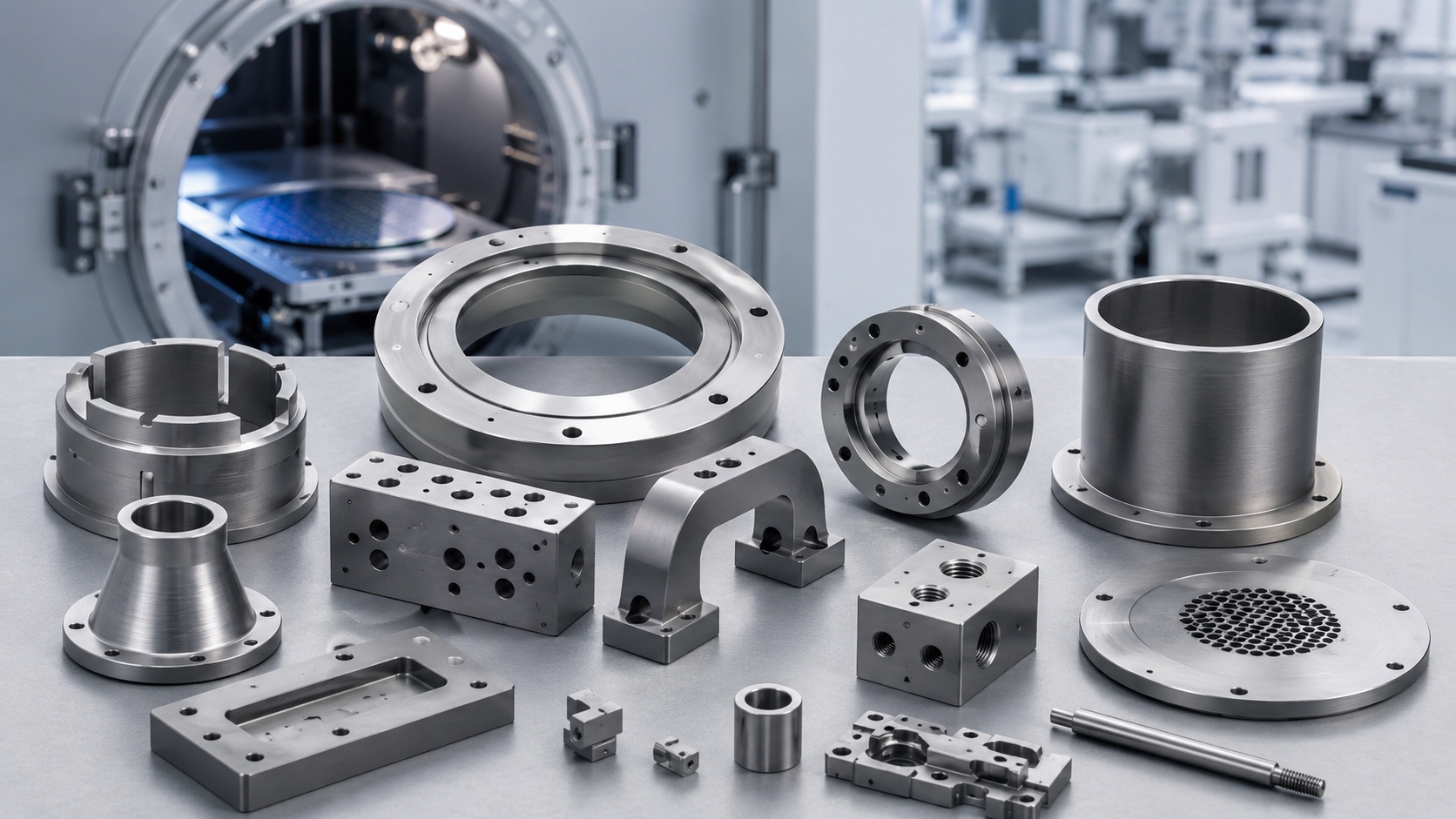
Project Background
Semiconductor manufacturing equipment often operates under high temperature, high vacuum, plasma exposure and strict contamination control requirements. In these environments, conventional engineering metals may not provide sufficient thermal stability, dimensional reliability or material purity.
Molybdenum and tungsten are widely used in advanced semiconductor equipment because of their high melting points, excellent thermal resistance, good vacuum compatibility and strong resistance to deformation under demanding operating conditions. However, these refractory metals are also difficult to machine, inspect and handle due to their hardness, brittleness and sensitivity to improper processing methods.
For this project, the customer required precision molybdenum and tungsten components for semiconductor equipment applications. The parts included small structural elements, thermal shielding components, fixture parts and precision-machined features used in high-temperature or vacuum-related assemblies.
The main objective was not only to produce parts according to drawings, but also to ensure stable machining quality, clean surface condition and reliable dimensional control throughout the production process.
Component Requirements
The components were designed for use in semiconductor equipment where dimensional stability and material reliability are critical. Typical requirements included:
- High-purity molybdenum or tungsten material
- Tight dimensional tolerances on critical features
- Stable flatness and parallelism control
- Clean machined surfaces without contamination
- Controlled edge conditions to avoid chipping
- Reliable inspection documentation
- Careful packaging to prevent surface damage during transportation
Because these parts may be installed close to thermal, vacuum or plasma-related environments, surface quality and material handling were especially important. Even small defects, embedded contamination or uncontrolled burrs could affect assembly performance or increase risk during equipment operation.
Manufacturing Challenges
Molybdenum and tungsten are much more difficult to machine than standard stainless steel, aluminum or titanium alloys.
Tungsten has extremely high density and hardness, which creates heavy cutting loads and rapid tool wear. Molybdenum is easier to machine than tungsten in some cases, but it can still be brittle, especially on thin edges, small holes or sharp corner features.
The main machining challenges included:
- Tool wear caused by high hardness and abrasive material behavior
- Edge chipping during milling, drilling or finishing
- Difficulty maintaining stable surface finish
- Risk of cracking or micro-damage under excessive cutting force
- Dimensional variation caused by heat and tool deflection
- Handling damage during machining, inspection and cleaning
For semiconductor applications, these challenges are more demanding because the parts are not only mechanical components. They must also meet strict cleanliness, surface and reliability expectations.
Engineering and Process Approach
Before machining, the drawings were reviewed carefully to identify critical dimensions, thin sections, sharp internal corners, hole features and areas with higher risk of chipping or deformation.
For molybdenum parts, the process focused on controlling cutting force and avoiding aggressive tool engagement. For tungsten components, machining parameters were selected more conservatively to reduce vibration, tool overload and edge fracture.
The manufacturing process included:
- Careful material selection and verification
- Stable fixture design to reduce vibration
- Low-stress machining strategy
- Optimized cutting parameters for refractory metals
- Step-by-step roughing and finishing process
- Controlled deburring and edge finishing
- Dimensional inspection after key machining stages
Instead of using aggressive material removal, the machining strategy emphasized stability, repeatability and surface protection. This approach helped reduce the risk of cracking, chipping and dimensional inconsistency.
Surface and Edge Control
For molybdenum and tungsten components, edge quality is a key issue. Sharp edges can chip easily, while excessive deburring may damage functional dimensions or change the intended geometry.
Therefore, the edge finishing process was controlled carefully according to drawing requirements. Functional edges were protected, while non-critical sharp edges were lightly broken to improve handling safety and reduce the risk of particle generation.
Surface finish was also controlled through stable tool paths, proper cutting tools and careful final inspection. For semiconductor equipment components, surface condition is not only an appearance issue. It can directly affect cleanliness, assembly reliability and long-term performance in vacuum or high-temperature systems.
Inspection and Quality Control
Quality control was implemented throughout the machining process rather than only at final inspection.
Critical dimensions were checked during production to confirm process stability before final finishing. Flatness, parallelism, hole position and key interface dimensions were measured according to drawing requirements.
Inspection methods included:
- Dimensional inspection with precision measuring tools
- Flatness and parallelism verification
- Visual inspection for chipping, cracks and surface defects
- Edge condition inspection
- Final documentation based on customer requirements
For parts used in semiconductor equipment, inspection must focus not only on tolerance numbers, but also on surface integrity and handling condition. The final parts were checked carefully before cleaning and packaging to ensure they were suitable for downstream assembly.
Final Result
The molybdenum and tungsten components were successfully manufactured according to the customer’s technical requirements. The final parts achieved stable dimensional accuracy, controlled edge quality and clean machined surfaces suitable for semiconductor equipment applications.
Through proper machining strategy, fixture control and inspection planning, the project reduced common risks associated with refractory metal machining, including edge chipping, tool-related surface defects and dimensional instability.
The customer received components that were ready for further assembly, testing or integration into equipment systems.
Engineering Value
This project demonstrated the importance of process experience when machining refractory metals for advanced industrial applications.
Molybdenum and tungsten components require more than standard CNC machining capability. Successful production depends on material understanding, cutting strategy, tool control, inspection discipline and careful handling.
For semiconductor equipment manufacturers, reliable refractory metal components can help improve thermal stability, vacuum compatibility and long-term equipment performance.
NOVA provides precision machining support for molybdenum, tungsten and other special metal components used in semiconductor, vacuum, aerospace and high-temperature equipment applications.