
Introduction
Superalloys such as Inconel, Hastelloy, Waspaloy, and other nickel-based or cobalt-based alloys are widely used in aerospace, energy, chemical processing, marine, and high-temperature industrial applications.
These materials are selected because they can maintain strength, corrosion resistance, and oxidation resistance under extreme working conditions. However, the same properties that make superalloys valuable in service also make them difficult to machine.
One of the most common challenges in superalloy machining is rapid tool wear. If tool wear is not properly controlled, it can increase machining cost, reduce dimensional accuracy, damage surface quality, and create delivery risks.
Understanding the causes of tool wear and applying practical control methods is essential for stable production of precision superalloy components.
Why Superalloys Cause Severe Tool Wear
Superalloys are difficult to machine because they generate high cutting forces and high cutting temperatures. Many superalloys have low thermal conductivity, so heat is concentrated near the cutting edge instead of being quickly transferred away from the workpiece.
At the same time, superalloys often retain high strength at elevated temperatures. This means the cutting tool must continue removing material even when the cutting zone becomes very hot.
In addition, nickel-based and cobalt-based alloys can cause strong adhesion between the workpiece material and the cutting tool. This may lead to built-up edge, edge chipping, notch wear, or sudden tool failure.
For these reasons, tool wear in superalloy machining is usually faster and more complex than in ordinary steel or aluminum machining.
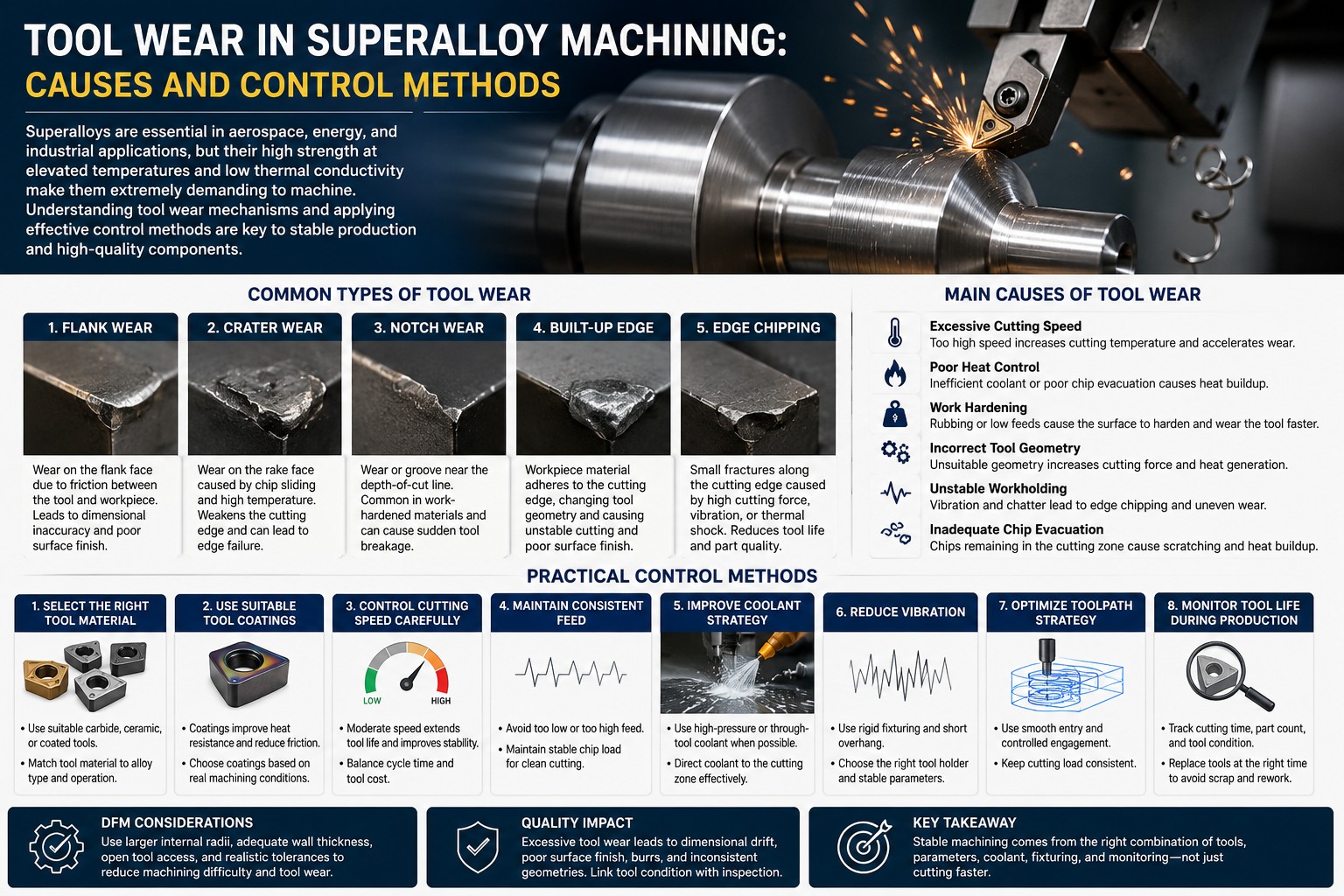
Common Types of Tool Wear in Superalloy Machining
1. Flank Wear
Flank wear occurs on the side of the cutting tool that contacts the machined surface. It is one of the most common forms of tool wear.
In superalloy machining, flank wear may develop quickly because of high cutting temperature, hard particles in the material, and continuous friction between the tool and workpiece.
Excessive flank wear can reduce dimensional accuracy, worsen surface finish, and increase cutting force.
2. Crater Wear
Crater wear forms on the rake face of the cutting tool, where chips slide over the tool surface. In superalloy machining, the chip-tool contact area can become extremely hot.
This heat, combined with chemical interaction between the tool and workpiece material, may gradually damage the rake face.
Crater wear weakens the cutting edge and may eventually lead to edge failure.
3. Notch Wear
Notch wear often occurs near the depth-of-cut line. It is especially common when machining work-hardened superalloys or when the cutting edge repeatedly passes through a hardened surface layer.
Notch wear can be dangerous because it may lead to sudden tool breakage. It is also difficult to control if the machining process is not properly planned.
4. Built-Up Edge
Built-up edge happens when workpiece material adheres to the cutting edge. This can change the effective tool geometry and cause unstable cutting.
In superalloy machining, built-up edge may result in poor surface finish, dimensional variation, and unpredictable tool life.
5. Edge Chipping
Edge chipping refers to small fractures along the cutting edge. It may be caused by high cutting force, vibration, interrupted cuts, poor tool selection, or unstable fixturing.
For precision superalloy components, edge chipping can quickly affect part quality and may require frequent tool replacement.
Main Causes of Tool Wear
1. Excessive Cutting Speed
High cutting speed is one of the most common causes of rapid tool wear in superalloy machining. When speed is too high, cutting temperature rises quickly and tool material may lose strength at the cutting edge.
Unlike aluminum or mild steel, many superalloys require more conservative cutting speeds to protect tool life and maintain process stability.
2. Poor Heat Control
Heat is a major factor in tool wear. Superalloys often do not conduct heat efficiently, so the tool absorbs much of the thermal load.
If coolant delivery is poor or chip evacuation is ineffective, heat can accumulate around the cutting zone. This accelerates flank wear, crater wear, and edge failure.
3. Work Hardening
Some superalloys work-harden during machining. If the tool rubs instead of cutting cleanly, the surface layer may become harder and more difficult to remove in the next pass.
This creates a cycle where tool wear increases, cutting forces rise, and machining becomes less stable.
4. Incorrect Tool Geometry
Tool geometry has a direct impact on cutting performance. A tool that is not sharp enough may increase friction and heat. A tool that is too weak may chip under heavy cutting loads.
For superalloys, tool geometry must balance edge sharpness, strength, chip control, and heat resistance.
5. Unstable Workholding
Poor workholding can cause vibration, chatter, and inconsistent cutting force. This is especially problematic when machining thin-wall parts, deep cavities, or complex aerospace-style components.
Vibration can cause edge chipping, poor surface finish, and shortened tool life.
6. Inadequate Chip Evacuation
Superalloy chips are often tough and difficult to break. If chips remain in the cutting zone, they can scratch the surface, damage the tool, and increase heat.
Chip evacuation is particularly important in slotting, pocketing, drilling, and internal machining operations.
Practical Control Methods
1. Select the Right Cutting Tool Material
Carbide tools are commonly used for superalloy machining. For certain operations, ceramic tools, coated carbide tools, or advanced tool materials may also be considered.
The correct tool choice depends on the alloy type, part geometry, operation type, tolerance requirement, and production quantity.
For roughing, tool strength and heat resistance are critical. For finishing, edge stability and surface quality are more important.
2. Use Suitable Tool Coatings
Tool coatings can help reduce friction, improve heat resistance, and extend tool life. However, coating selection should not be treated as a universal solution.
The coating must match the machining condition. A coating that works well in one superalloy application may not perform well in another if cutting speed, coolant, chip load, or tool geometry is different.
3. Control Cutting Speed Carefully
In superalloy machining, higher speed does not always mean higher productivity. Excessive speed may reduce tool life so much that the total cost becomes higher.
A practical process should balance cycle time, tool cost, surface quality, and dimensional stability. Stable cutting is usually more valuable than aggressive cutting when machining high-value superalloy parts.
4. Maintain Consistent Feed
Too low a feed rate can cause rubbing, heat generation, and work hardening. Too high a feed rate can overload the cutting edge and cause chipping.
The goal is to maintain a stable chip load so the tool cuts cleanly instead of rubbing against the workpiece.
5. Improve Coolant Strategy
Coolant delivery is critical for controlling heat and removing chips. In superalloy machining, standard coolant may not be enough for deep pockets, drilling, or high-engagement cutting.
High-pressure coolant or through-tool coolant can improve chip evacuation and reduce heat concentration. Coolant direction should be aimed directly at the cutting zone whenever possible.
6. Reduce Vibration
Tool wear often becomes worse when the cutting process is unstable. To reduce vibration, the setup should use rigid workholding, short tool overhang, proper tool holder selection, and stable machining parameters.
For thin-wall or complex components, machining sequence should be carefully planned to keep the part supported during critical operations.
7. Optimize Toolpath Strategy
Modern toolpath strategies can help reduce tool wear by controlling engagement and cutting load.
Instead of using heavy conventional cuts, many superalloy parts benefit from controlled radial engagement, smooth tool entry, stable chip thickness, and consistent cutting force.
Good toolpath planning can reduce heat spikes, improve tool life, and make production more predictable.
8. Monitor Tool Life During Production
Superalloy machining should not rely only on visual inspection after a tool fails. Tool life should be monitored based on cutting time, number of parts, surface condition, dimensional trend, and machine load where applicable.
Replacing tools at the right time helps avoid scrap, rework, and unexpected production interruptions.
DFM Considerations for Reducing Tool Wear
Part design has a direct impact on tool wear. Deep narrow slots, sharp internal corners, thin walls, small radii, and difficult-to-access features can increase machining difficulty.
When possible, engineers should consider larger internal radii, practical wall thickness, open tool access, and realistic tolerance requirements.
For superalloy components, early DFM review can reduce tool wear, improve machining stability, and lower total manufacturing cost.
A small design adjustment can sometimes save significant machining time and tool cost.
Quality Impact of Tool Wear
Tool wear does not only affect production cost. It can also affect final part quality.
Excessive tool wear may cause dimensional drift, poor surface finish, burrs, edge damage, and inconsistent geometry. For aerospace, energy, chemical processing, or semiconductor-related components, these issues may lead to inspection failure or functional risk.
For critical superalloy parts, tool condition should be linked with inspection planning. Important dimensions, surface roughness, and critical edges should be checked carefully during production.
Conclusion
Tool wear is one of the key challenges in superalloy machining. It is caused by high temperature, high cutting force, work hardening, adhesion, vibration, and difficult chip evacuation.
Controlling tool wear requires a complete process approach, including proper tool selection, suitable cutting parameters, effective coolant delivery, rigid workholding, optimized toolpaths, and continuous tool life monitoring.
For high-value superalloy components, stable machining is more important than simply cutting faster. A well-planned process helps reduce cost, improve quality, and ensure reliable delivery.