
Introduction
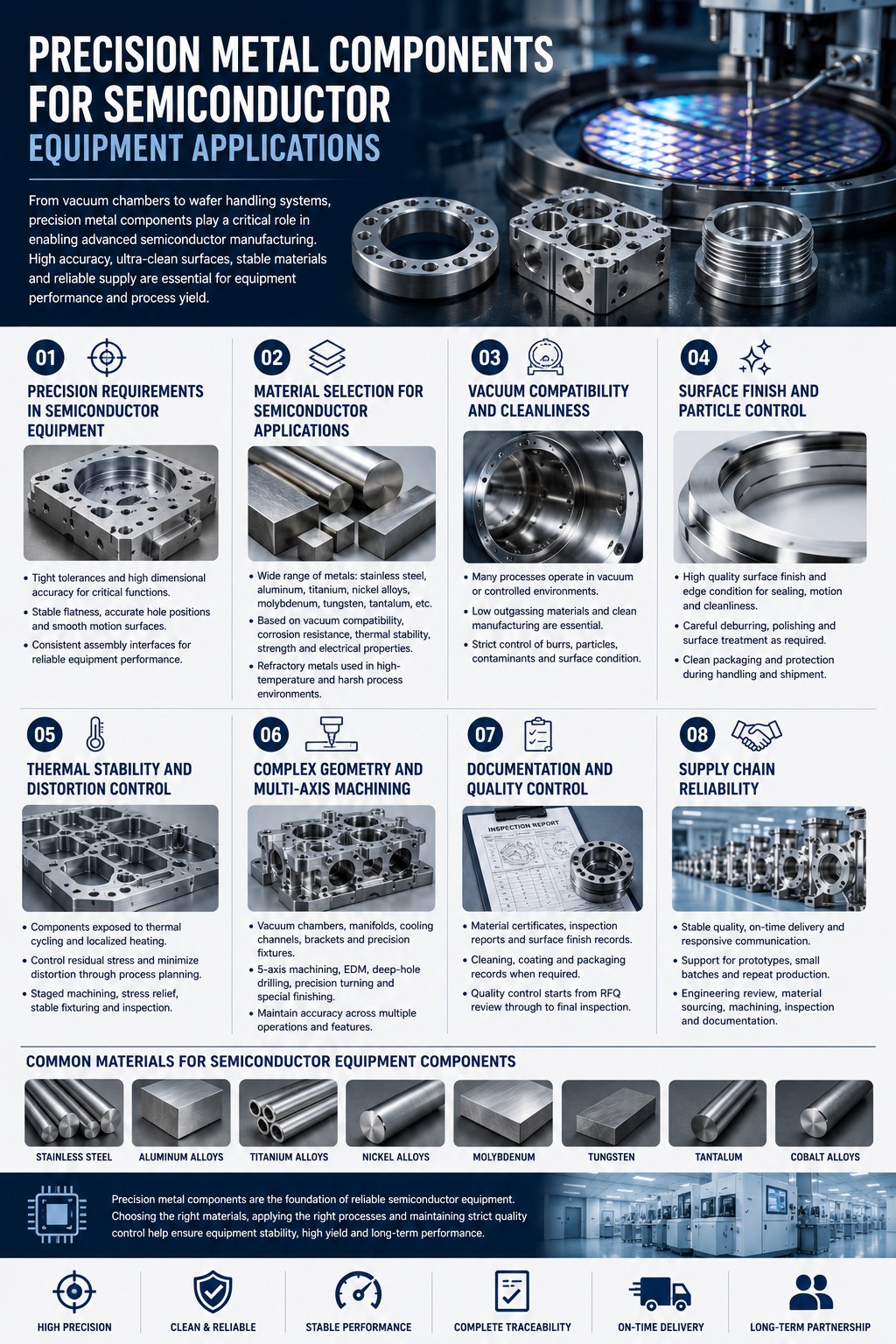
Semiconductor manufacturing equipment depends on a large number of precision metal components. These parts may be used in vacuum chambers, wafer handling systems, process modules, gas delivery systems, thermal assemblies, inspection equipment, fixtures and structural mechanisms.
As semiconductor production becomes more advanced, equipment components must meet higher requirements for dimensional accuracy, surface quality, cleanliness, material stability and long-term reliability.
The semiconductor equipment market continues to expand with investment in advanced logic, memory and AI-related capacity. SEMI reported that worldwide semiconductor manufacturing equipment sales reached $135.1 billion in 2025, up 15% from 2024. This growth creates stronger demand for reliable precision machined components and specialized material capability.
1. Precision Requirements in Semiconductor Equipment
Semiconductor equipment components often require tight tolerances, stable flatness, accurate hole positions, smooth motion surfaces and consistent assembly interfaces.
Even small dimensional errors can affect sealing, alignment, wafer movement, gas flow, thermal transfer or equipment stability. For this reason, precision machining for semiconductor applications must focus not only on part shape, but also on repeatability and process control.
Critical features may include sealing grooves, mounting surfaces, precision bores, threaded holes, thin walls, locating features and complex multi-axis surfaces.
2. Material Selection for Semiconductor Applications
Semiconductor equipment uses a wide range of materials. Common metal materials may include stainless steel, aluminum alloys, titanium alloys, nickel alloys, molybdenum, tungsten, tantalum and other high-performance metals. Equipment manufacturers also use difficult-to-process non-metal materials such as quartz glass and carbon graphite in some systems.
Material selection depends on the working environment. Vacuum compatibility, corrosion resistance, thermal stability, electrical properties, outgassing behavior, mechanical strength and surface treatment requirements may all affect the final material choice.
For high-temperature or harsh process environments, refractory metals such as molybdenum, tungsten, TZM and tantalum may be used in semiconductor tooling and ion implant equipment.
3. Vacuum Compatibility and Cleanliness
Many semiconductor processes are performed in vacuum or controlled environments. Vacuum conditions help reduce impurities and support stable film formation, etching and other process steps.
For machined metal components, this means burrs, particles, trapped contaminants, poor surface finish and unstable materials can create serious risks. A part may be dimensionally correct but still unsuitable if the surface condition or cleanliness is not properly controlled.
Good manufacturing practice may include careful deburring, controlled surface finishing, cleaning, packaging and protection during handling.
4. Surface Finish and Particle Control
Surface quality is especially important for semiconductor equipment components.
Poor machining marks, sharp edges, burrs, scratches or loose particles can affect sealing, motion, cleanliness and process stability. In some applications, surface roughness and edge condition must be controlled more strictly than in general industrial machining.
Manufacturers need to select suitable cutting tools, toolpaths, finishing methods and inspection procedures. For critical surfaces, additional processes such as polishing, grinding, lapping, passivation, anodizing, electropolishing or coating may be required depending on the material and application.
5. Thermal Stability and Distortion Control
Semiconductor equipment often includes components exposed to thermal cycling, localized heating or temperature-sensitive assembly conditions.
For precision metal parts, thermal stability and distortion control are important. Material removal, residual stress, thin-wall geometry and uneven machining can all cause dimensional movement.
To reduce risk, manufacturers may need staged machining, stress relief, balanced material removal, stable fixturing and intermediate inspection. This is especially important for large plates, chamber components, precision frames, thin-wall structures and parts with tight flatness requirements.
6. Complex Geometry and Multi-Axis Machining
Semiconductor equipment components often have complex geometry. Examples include vacuum chamber parts, manifolds, cooling channels, precision brackets, wafer handling arms, sealing components, gas flow components and high-precision fixtures.
These parts may require 3-axis, 4-axis or 5-axis CNC machining, EDM, deep-hole drilling, precision turning, grinding or special finishing.
The key challenge is not only producing the geometry, but maintaining accuracy across multiple operations and ensuring that all critical features remain stable after machining.
7. Documentation and Quality Control
Semiconductor equipment suppliers often require clear quality documentation. This may include material certificates, dimensional inspection reports, surface finish records, cleaning notes, coating records and packaging requirements.
For precision metal components, reliable documentation helps customers verify that the part meets technical requirements before assembly.
Quality control should begin at RFQ review. Material grade, tolerance, surface finish, critical features, inspection method and packaging requirements should be confirmed before production starts.
8. Supply Chain Reliability
Semiconductor equipment production requires stable supply chains. Equipment manufacturers and subsystem suppliers often need repeatable quality, responsive engineering communication and reliable delivery schedules.
Because semiconductor projects may involve frequent design changes, prototype builds, small batches and repeat orders, suppliers must be flexible but disciplined.
A strong machining supplier should be able to support engineering review, material sourcing, prototype machining, production planning, inspection and documentation.
Conclusion
Precision metal components play an important role in semiconductor equipment applications. These parts support vacuum systems, process modules, wafer handling, thermal control, gas delivery, inspection equipment and structural assemblies.
Successful manufacturing requires more than CNC machining capacity. It requires material knowledge, precision process control, surface quality management, distortion control, cleanliness awareness and reliable documentation.
Nova Special Metals supports precision machining solutions for stainless steel, aluminum, titanium, nickel alloys, molybdenum, tungsten, tantalum and other high-performance metals used in demanding industrial applications.
For semiconductor equipment components, early engineering review can help reduce manufacturing risk, improve dimensional stability and support reliable long-term production.