
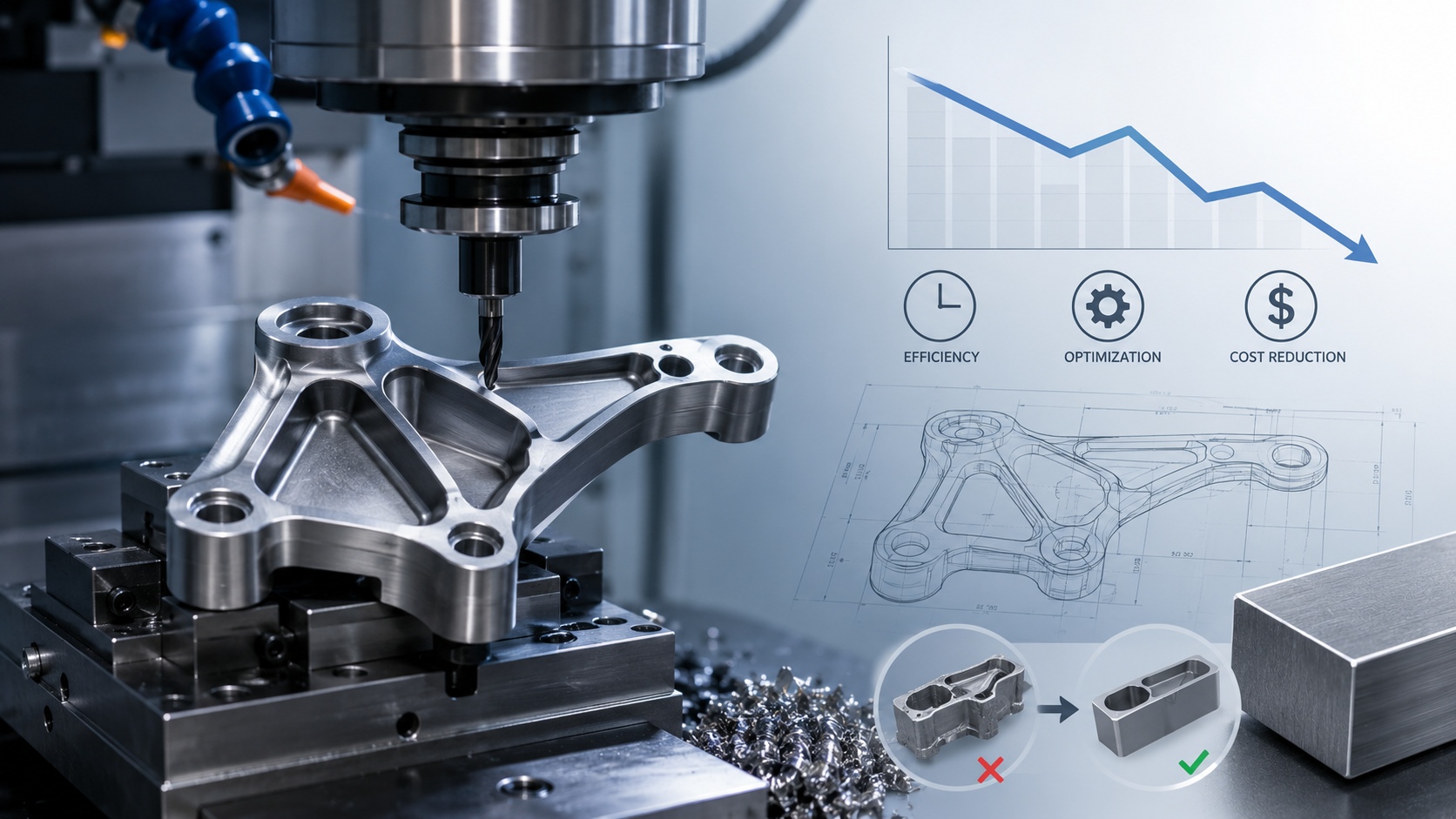
Titanium alloys are widely used in aerospace, medical, marine, semiconductor, and high-performance industrial applications because of their excellent strength-to-weight ratio, corrosion resistance, and temperature capability. However, titanium is also one of the more challenging materials to machine.
Compared with aluminum or stainless steel, titanium machining usually requires lower cutting speeds, stronger tooling, more careful heat control, and more stable process planning. As a result, the machining cost of titanium parts can increase quickly if the design is not optimized for manufacturability.
For buyers, engineers, and sourcing teams, the best way to control titanium part cost is not simply to ask for a lower unit price. The most effective method is to reduce unnecessary machining complexity at the design stage.
This article explains practical ways to reduce machining cost in titanium parts without compromising functional performance.
1. Choose the Right Titanium Grade
Material selection has a direct impact on machining cost.
The most common titanium alloy for precision components is Ti-6Al-4V / Grade 5, which offers a strong balance of mechanical strength, corrosion resistance, and availability. However, it is harder to machine than commercially pure titanium grades.
For parts that do not require the full strength of Ti-6Al-4V, commercially pure titanium such as Grade 2 may be easier and more economical to machine. In some applications, selecting a more machinable grade can reduce tool wear, cycle time, and overall production cost.
Before finalizing the material, engineers should ask:
- Is high strength truly required?
- Is corrosion resistance the main requirement?
- Is the selected titanium grade over-specified?
- Are equivalent grades acceptable?
A small adjustment in grade selection can sometimes create a meaningful cost reduction.
2. Avoid Overly Tight Tolerances
Titanium machining cost increases significantly when tolerances are unnecessarily tight.
Tight tolerances require slower machining, more inspection, more tool control, and sometimes additional finishing operations. For titanium parts, this cost impact is often greater because the material is more difficult to cut and more sensitive to heat buildup.
A common DFM principle is simple:
Use tight tolerances only where they are functionally necessary.
For non-critical surfaces, general tolerances should be used whenever possible. Critical features such as sealing surfaces, bearing fits, alignment holes, or mating interfaces can still be controlled tightly, but the entire part does not need the same precision level.
Good tolerance design helps reduce:
- Machining time
- Inspection cost
- Scrap risk
- Tool replacement frequency
- Production delays
For titanium parts, tolerance control is one of the most effective cost-saving methods.
3. Simplify Part Geometry
Complex geometry usually means longer machining time and higher cost.
Deep pockets, thin walls, narrow slots, sharp internal corners, undercuts, and hard-to-reach features all increase titanium machining difficulty. These features may require special tools, additional setups, slower feeds, or EDM/secondary operations.
To reduce cost, engineers should simplify the part geometry where possible:
- Avoid unnecessary deep cavities
- Increase internal corner radius
- Reduce extremely thin wall sections
- Avoid narrow grooves that require small tools
- Minimize undercuts and hidden features
- Keep tool access in mind during design
Titanium parts are often used in high-performance applications, so some complexity may be unavoidable. However, even small design changes can improve machinability and reduce cost.
For example, increasing an internal radius may allow the use of a larger, stronger cutting tool. This can improve tool life, reduce vibration, and shorten machining time.
4. Reduce the Number of Setups
Every additional setup adds time, cost, and risk.
When a titanium part must be repositioned several times during machining, the supplier needs extra fixture preparation, alignment, inspection, and operator time. Multiple setups also increase the risk of tolerance stack-up and dimensional variation.
A cost-effective design should consider how the part will be held and machined.
Designers can reduce setup cost by:
- Keeping important features accessible from fewer directions
- Avoiding unnecessary features on multiple sides
- Designing stable clamping surfaces
- Grouping critical features on the same machining side
- Avoiding geometries that require complex custom fixtures
For low-volume titanium parts, setup cost can represent a large portion of the total price. Reducing setups is especially important for prototypes, trial orders, and small production batches.
5. Control Thin-Wall and Lightweight Structures Carefully
Titanium is often selected for lightweight components, especially in aerospace and high-performance applications. However, thin-wall titanium parts can be expensive to machine.
Thin walls are prone to vibration, deformation, and heat-related distortion. To machine them correctly, suppliers may need lighter cutting parameters, special fixtures, stress-relief steps, and additional inspection.
To reduce cost, engineers should avoid making walls thinner than necessary.
When thin-wall structures are required, it is helpful to:
- Maintain uniform wall thickness
- Avoid sudden thickness transitions
- Add temporary support features if possible
- Use generous radii at transitions
- Discuss machining sequence with the supplier early
Good thin-wall design can reduce deformation risk and improve production stability.
6. Minimize Material Removal
Titanium raw material is expensive, and machining away excessive material also increases cycle time.
For titanium parts, the starting stock size should be considered carefully. If the part is machined from a large billet with a high material removal rate, cost will rise quickly.
Possible ways to reduce material removal include:
- Using near-net-shape forging where suitable
- Selecting a more appropriate bar, plate, or block size
- Redesigning the part to reduce unnecessary bulk
- Considering welded or assembled structures for some applications
- Optimizing the blank size before machining
For high-value titanium components, reducing material waste can have a major impact on total cost.
7. Design with Standard Tooling in Mind
Special tools increase machining cost.
If a part requires very small tools, long-reach tools, custom cutters, or special thread tools, the supplier may need to purchase tooling specifically for the project. This adds cost and can also increase lead time.
To improve manufacturability, designers should use standard feature sizes whenever possible.
Examples include:
- Standard hole sizes
- Standard thread specifications
- Reasonable slot widths
- Larger corner radii
- Avoiding excessive depth-to-diameter ratios
Standard tooling usually means better tool availability, faster production, and lower machining risk.
8. Optimize Surface Finish Requirements
Surface finish is another common cost driver.
Titanium parts may require fine surface finishes for sealing, fatigue resistance, medical use, or corrosion-related applications. However, specifying a fine finish on every surface is usually unnecessary.
A practical approach is to define surface finish based on function:
- Critical sealing surfaces: tighter finish control
- Mating surfaces: controlled finish as required
- Non-functional surfaces: standard machined finish
- Cosmetic surfaces: only if appearance matters
Unnecessary polishing, grinding, or fine machining can increase cost without improving performance.
9. Communicate Application Requirements Clearly
A good supplier can often suggest cost-saving options, but only if the application requirements are clear.
When requesting a quote for titanium parts, it is useful to provide:
- Material grade
- Drawing and 3D model
- Annual or batch quantity
- Critical tolerances
- Surface finish requirements
- Heat treatment or finishing needs
- Inspection requirements
- Application background, if available
Clear technical information helps the supplier identify which features are critical and which areas can be simplified.
This is especially important for titanium parts because the process plan, tooling strategy, and inspection method can strongly affect the final cost.
Conclusion
Reducing the machining cost of titanium parts is mainly a design and process planning issue.
The most effective cost-saving methods include selecting the right titanium grade, avoiding unnecessary tight tolerances, simplifying geometry, reducing setups, controlling thin-wall structures, minimizing material removal, using standard tooling, and optimizing surface finish requirements.
For high-performance titanium components, the goal is not to make the part “cheap.” The goal is to make the part manufacturable, stable, and cost-effective while maintaining its required engineering performance.
At Nova Special Metals, we support precision machining of titanium and other special metals for demanding industrial applications. By reviewing drawings, tolerances, material requirements, and machining risks early, we help customers improve manufacturability and reduce unnecessary production cost.