
Project Background
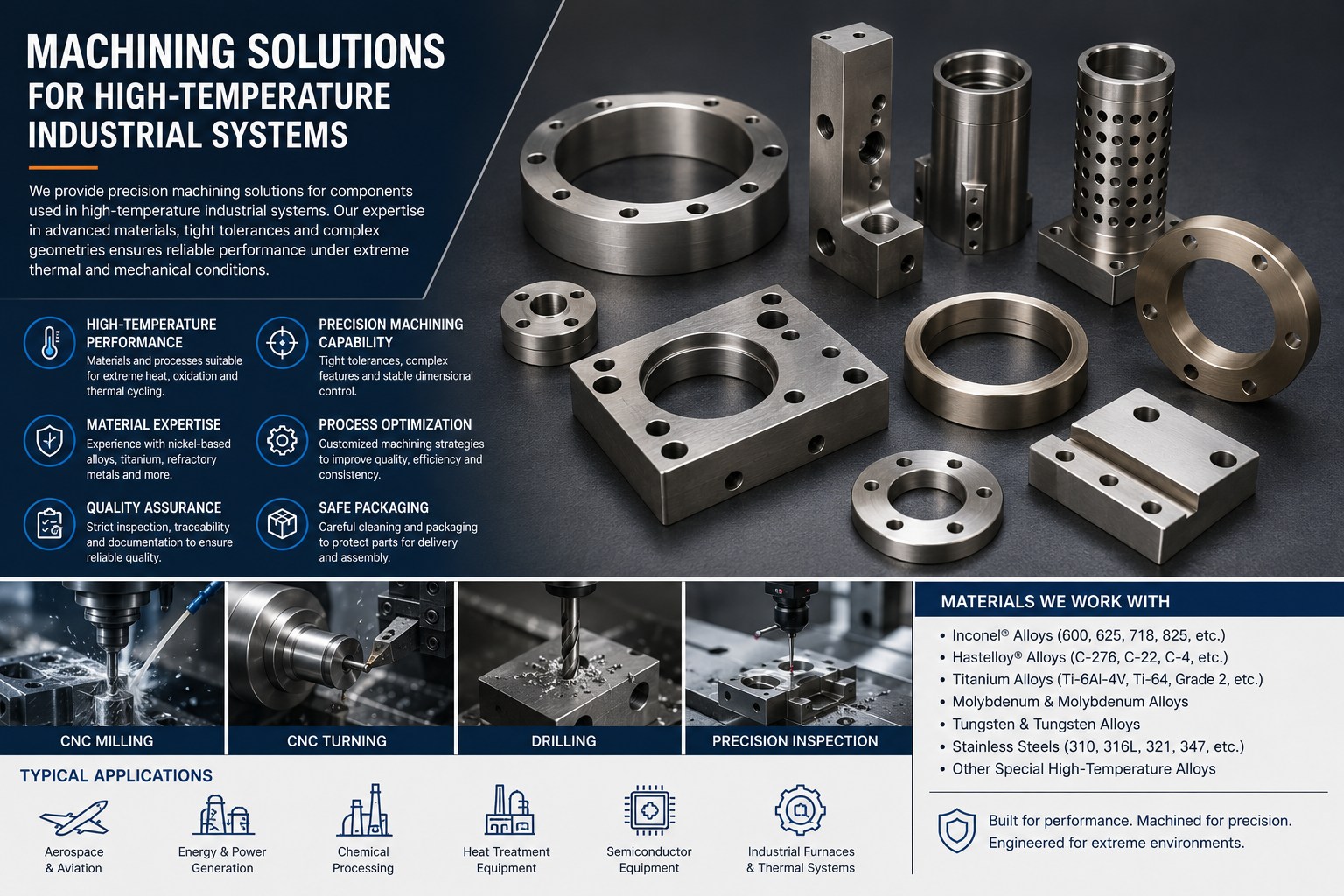
High-temperature industrial systems are widely used in aerospace, energy, chemical processing, semiconductor equipment, thermal treatment systems and advanced manufacturing applications. These systems often operate under extreme heat, thermal cycling, mechanical stress, oxidation risk and strict dimensional requirements.
In such environments, conventional materials may lose strength, deform, oxidize or fail prematurely. Therefore, high-performance alloys and refractory metals are often selected for critical components. These materials may include Inconel, Hastelloy, titanium alloys, molybdenum, tungsten and other special metals depending on the operating temperature, load condition and chemical environment.
For this project, the customer required precision-machined components for high-temperature industrial equipment. The parts included structural supports, thermal shielding elements, mounting blocks, spacers, rings, sleeves and custom mechanical components used in demanding thermal environments.
The key objective was to provide stable machining quality, reliable dimensional control and material-specific manufacturing solutions suitable for high-temperature operating conditions.
Component Requirements
The components were designed for industrial systems where heat resistance, mechanical stability and long-term reliability were critical. Typical requirements included:
- High-temperature material performance
- Stable dimensional accuracy after machining
- Good resistance to thermal deformation
- Controlled flatness and parallelism
- Clean machined surfaces
- Accurate holes, slots and mounting features
- Controlled burrs and edge conditions
- Material traceability and inspection documentation
- Careful packaging to protect finished parts
Because these parts were used in high-temperature assemblies, dimensional stability was especially important. Even small machining errors, surface defects or uncontrolled distortion could affect assembly accuracy, thermal performance or equipment reliability.
Manufacturing Challenges
Machining parts for high-temperature systems is often more difficult than machining standard industrial components.
High-temperature alloys and refractory metals usually have poor machinability, high cutting resistance and strong tool wear behavior. Some materials are hard and abrasive, while others are tough, sticky or sensitive to heat buildup during machining.
The main challenges included:
- Rapid tool wear during cutting
- High cutting force and vibration risk
- Difficulty maintaining tight tolerances
- Heat generation during machining
- Risk of distortion in thin or complex parts
- Burr formation on holes and edges
- Surface damage caused by improper tools or parameters
- Need for different machining strategies for different materials
Because each high-temperature material behaves differently, one standard machining method cannot be applied to all components. The process must be adjusted according to material type, geometry and final application.
Engineering and Process Approach
Before machining, the drawings were reviewed carefully to identify critical dimensions, heat-exposed surfaces, mounting interfaces, thin sections, deep pockets, hole patterns and areas with higher risk of distortion.
The manufacturing plan was developed based on the material properties and part geometry. For nickel-based alloys, the focus was on tool wear control and heat management. For refractory metals such as molybdenum or tungsten, the process emphasized stable cutting, edge protection and reduced risk of cracking or chipping. For titanium components, the strategy focused on controlling heat buildup and preventing distortion.
The process included:
- Material verification before production
- DFM review of critical features
- Stable fixture design
- Controlled roughing and finishing sequence
- Optimized cutting tools and machining parameters
- In-process inspection of critical dimensions
- Careful deburring and edge finishing
- Final dimensional and visual inspection
Instead of focusing only on machining speed, the process was designed around stability, repeatability and quality control. This helped reduce production risk and improve consistency for high-temperature industrial components.
Tolerance and Distortion Control
For components used in high-temperature systems, tolerance control is closely related to machining stress, heat generation and part geometry.
If too much material is removed too quickly, internal stress may be released unevenly, causing deformation. Thin walls, large flat surfaces, ring-shaped components and long structural parts are especially sensitive to distortion.
To reduce these risks, the machining process used a step-by-step approach. Rough machining was separated from finishing where necessary, and critical surfaces were machined with controlled cutting depth and stable clamping conditions.
Key control methods included:
- Balanced material removal
- Stable workholding
- Reduced cutting force during finishing
- Proper tool selection
- Intermediate inspection
- Controlled final passes on critical surfaces
This approach helped maintain dimensional accuracy and reduce the risk of unexpected deformation after machining.
Surface and Edge Control
Surface condition is important for high-temperature industrial components because surface defects may become starting points for oxidation, fatigue, cracking or assembly problems.
The machining process focused on producing clean surfaces without deep tool marks, uncontrolled scratches, cracks, heavy burrs or damaged edges.
Special attention was given to:
- Mounting surfaces
- Sealing or contact areas
- Heat-exposed faces
- Hole edges
- Thin features
- Internal corners and transition areas
Edges were finished carefully according to drawing requirements. Functional edges were protected, while non-critical sharp edges were lightly broken to improve handling safety and reduce the risk of burr-related assembly issues.
Inspection and Quality Control
Quality control was implemented throughout the production process.
Critical dimensions were inspected during machining to confirm process stability before final finishing. Final inspection focused on both dimensional accuracy and surface condition.
Typical inspection items included:
- Overall dimensions
- Hole diameter and position
- Flatness and parallelism
- Thickness and wall features
- Surface finish condition
- Edge and burr inspection
- Visual inspection for cracks, scratches or machining defects
- Material documentation and traceability review
For high-temperature applications, inspection must consider not only whether the part meets drawing tolerances, but also whether the part is suitable for reliable service in demanding operating environments.
Final Result
The high-temperature industrial components were successfully manufactured according to the customer’s technical requirements. The finished parts achieved stable dimensional accuracy, controlled surface condition and reliable machining quality.
Through proper material understanding, fixture planning, cutting parameter control and inspection discipline, the project reduced common risks such as tool wear, distortion, burr formation and surface damage.
The completed components were suitable for integration into high-temperature industrial systems and related advanced equipment assemblies.
Engineering Value
This project demonstrated the importance of material-specific machining solutions for high-temperature industrial applications.
High-temperature components are not ordinary metal parts. Their manufacturing quality depends on the correct combination of material knowledge, process planning, tool control, dimensional inspection and careful handling.
NOVA supports precision machining of special metal components for high-temperature systems, including nickel-based alloys, titanium alloys, refractory metals and other advanced engineering materials used in aerospace, semiconductor, energy, chemical processing and industrial equipment applications.